
Boardrooms: The Eye of the Storm
Why boardrooms often feel calm while organisations struggle, how culture adapts to protect leadership, and what happens when dissent is quietly punished instead of surfaced.
Share this article:
How culture shapes what leaders see and why calm can be misleading
Let us begin where this story always begins.
Not with culture. Not with leadership theory. But with what actually happens.
You are in a senior meeting. Progress is being reported.
A composed voice says, without hesitation
- We have met with the stakeholders
- There was good discussion
- We have agreed to meet again
Heads nod. Notes are taken. The update is accepted. The agenda moves on.
- No decision closed.
- No outcome changed.
- No risk reduced.
In another meeting, another week, the same pattern appears wearing different clothes. Percentages are shared. Tasks are marked complete. Slides glow green. Yet the tasks are not tethered to outcomes. They orbit them. Busy satellites circling a result they never quite land on.
Sometimes the pattern tightens further.
""We cannot report that, it doesn't look good.""
We cannot report that, it does not look good
So the figures are softened. Deferred. Reframed. Not fabricated perhaps, but not allowed to be fully real either. Reality is edited to protect the room.
From the outside, it looks like progress.
From the inside, nothing has moved.
This is not incompetence.
It is culture under pressure.
And this is where the storm enters the room.
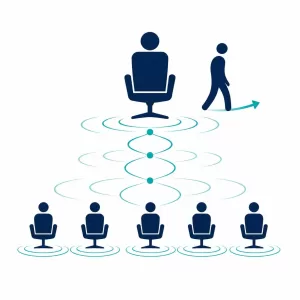
In a hurricane, the most deceptive place is the eye. Calm. Still. Clear skies overhead. The chaos has not disappeared. It has organised itself around the centre.
The boardroom is always that place.
By definition, it sits at the point of maximum consequence and maximum insulation. Pressure from customers, markets, regulation, delivery and reputation converges toward it. Decisions made there shape the entire system. The calm is not accidental. It is structural.
The question is not whether the boardroom is the eye of the storm.
It always is.
The real question is how the organisation learns to inform it.
As pressure rises across the organisation, turbulence spreads outward first. Delivery teams feel it early. Customers feel it next. Middle layers absorb the noise and translate it upwards into something more presentable. By the time it reaches the boardroom, it arrives as dashboards, summaries, confident language and reassuring structure.
The room stays calm.
That calm feels like control. It feels like leadership. It feels like competence.
But often, it is insulation.
When leaders remain in the boardroom, reality arrives filtered. Chaos becomes discussion. Risk becomes narrative. Fear becomes professionalism. Over time, a quiet bargain forms. If the room feels calm, the system must be under control.
You may think this is denial when in fact it is distance as a barrier from the chaos.
And fear does the rest.
- Fear of exposure.
- Fear of being visibly wrong.
- Fear of closing a decision too early and wearing the consequence alone.
Tasks feel safer than outcomes. Meetings feel safer than decisions. Alignment feels safer than dissent. Discussion becomes a currency because it carries no personal cost.
And this is where culture learns fastest.
Something is being punished.
Rarely loudly. Rarely formally. But consistently.
What attracts consequence is not being wrong. It is being early. It is being direct. It is disturbing the calm of the room.
Dissent is taxed.
""This is how Culture learns what not to do.""
Those who name risk before there is permission feel it first. They lose airtime. Their points are acknowledged and set aside. They stop being invited into pre reads and informal conversations. Nothing explicit is said, yet the message lands.
This is how culture learns what not to do.
Reassurance, meanwhile, is rewarded not because it is true, but because it is comfortable.
- So progress is reported as activity.
- Motion replaces meaning.
- Stillness in the boardroom is mistaken for stewardship.
This is how culture evolves.
Not through values statements or transformation programmes, but through repeated signals about what is safe. People watch what happens when uncomfortable truth arrives at the centre.
- What gets welcomed.
- What gets rewarded.
- What gets protected.
If early bad news is met with curiosity, culture learns to surface reality.
If it is met with discomfort, deflection or silence, culture learns to intercept reality before it reaches the table.
No instruction is required. Culture adapts naturally.
Over time, culture becomes the climate system around the boardroom.
In healthy organisations, culture behaves like a sensor. It conducts pressure upward. It reports changes in the weather early, accurately, sometimes uncomfortably. Bad news travels fast. Outcomes matter more than optics. Meetings end with decisions. Silence after a decision is normal.
The boardroom feels less calm.
The organisation becomes more resilient.
In brittle organisations, culture becomes insulation. It absorbs shocks so the boardroom remains dry. Reality is slowed, reframed, deodorised. Dashboards replace stories. Percentages replace consequences. Meetings replace decisions.
The boardroom stays calm.
The storm intensifies elsewhere.
""When the eye of the storm passess, consequence arrives unpolitely and all at once.""
Eventually, the eye passes.
What arrives next is not confusion, but consequence. By then, the organisation has spent months rehearsing activity instead of learning. When reality finally breaks through, it does not arrive politely or gradually. It arrives all at once.
Now imagine something different.
Leaders recognise that calm is not a virtue. It is a choice.
They leave the boardroom. Not symbolically. Practically. They test the weather themselves. Not through visits staged for reassurance, but through unscripted contact with customers, frontline teams, and delivery reality. They listen to unprocessed signals before they are tidied. They invite bad news early and protect the people who bring it. They ask one question relentlessly;
What is different because of this work?
Meetings shorten. Decisions close. Silence follows clarity. Some outcomes are uncomfortable. Some bets fail early. Learning accelerates.
Fear does not vanish. It is human. But it no longer runs the system. Clarity becomes safer than concealment. Outcomes matter more than performance theatre. Movement replaces choreography.
Culture responds immediately.
- It stops protecting the boardroom and starts informing it.
- It becomes a messenger rather than a shield.
- A weather vane rather than an umbrella.
Leadership, in this sense, is not about standing calmly in the eye of the storm.
It is about deciding what the calm is used for.
Calm can be used to delay exposure.
Or it can be used to absorb reality and decide while there is still time to move.
That choice trains culture. Quietly. Reliably. Every week.
So yes. The boardroom is always the eye of the storm, and Culture always informs it.
What differentiates organisations is how culture learns to do that.
And that lesson is taught not in speeches or values decks, but in what happens when the weather turns and someone decides whether the truth is welcome in the room.
If this resonates and you would like to explore it in confidence, you are welcome to schedule time with me. Not to be advised or fixed, but to think clearly, privately, and without theatre about what the calm in your boardroom may be protecting.
Read more blog posts
15 Jul 2025
Daily Lens: “Good Anger” Is the New Competitive Advantage
When was the last time your team turned irritation into catalyst, not crisis?

11 May 2026
When Strong Leadership Becomes Organisational Dependency
The JPMorgan governance debate is not just about separating chair and CEO roles. It reveals a wider boardroom risk: strong performance can make dependency harder to challenge.
04 May 2026
Berkshire Hathaway Succession: What Greg Abel’s First Meeting Reveals About Culture
Greg Abel’s first Berkshire Hathaway annual meeting shows that succession is not only about replacing a chief executive. It is about whether the behaviours that shaped the culture still produce trust when the defining leader steps back.
Get in touch
We want to hear from you
If you're ready to break bias, decode decisions and unlock success, we're here to help. Let's get your transformation journey started!