
Compliance Is Not Governance: Why Organisations Confuse Evidence with Judgement
Compliance proves obligation. Governance directs judgement. When organisations confuse the two, they risk creating false assurance: evidence without effect and structure without control.
Share this article:
Compliance vs Governance: How False Assurance Takes Root
Organisations rarely fail because they have no language for compliance, governance, risk or accountability.
They fail because the language is applied without shared meaning.
No one has checked what the words mean in practice. The result is an organisation separated by a common language: familiar words, different meanings, and no shared test of what those words require.
People say “owner”, “controlled”, “approved”, “escalated”, “assured”, “reviewed” and “governed” as if everyone around the table means the same thing.
Often, they do not.
The board, the executive team, the compliance function, operational leaders and delivery teams may all use the same vocabulary while applying it in different ways. One group may hear “owner” and think accountability. Another may hear “owner” and think administration. Another may hear it and think blame.
That is where the problem begins.
The organisation appears aligned because the words are familiar. In practice, it may be working from several different assumptions about who owns what, what has actually been decided, what evidence proves, and what level of judgement has really been applied.
This is especially true in the relationship between compliance and governance.
They are often spoken about together. They are often placed beside each other in reports. They are often treated as part of the same broad assurance landscape.
But they are not the same thing.
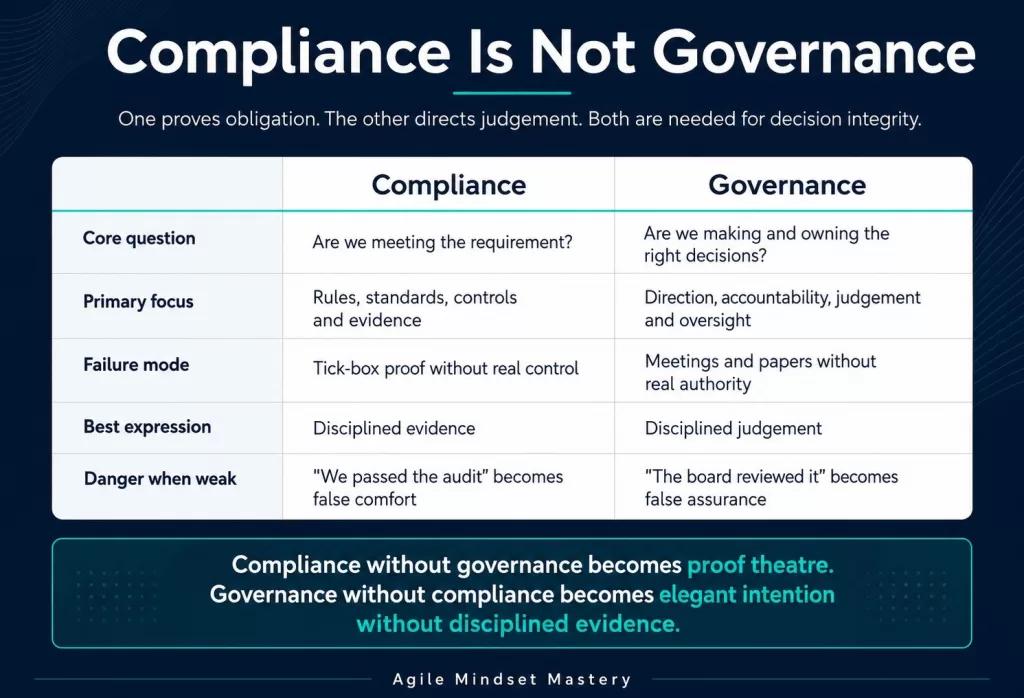
Compliance asks:
Are we meeting the requirement?
Governance asks:
Are we making and owning the right decisions?
Both matter. Both are necessary. But when they are confused, the organisation can become very good at producing evidence without becoming meaningfully better at judgement.
The Distinction Matters
Compliance is concerned with obligations. These may come from law, regulation, standards, contracts, internal policies, ethical commitments or stakeholder expectations. ISO 37301 frames compliance management as a system for establishing, implementing, evaluating, maintaining and improving how an organisation meets its compliance obligations.
Governance is broader. It is about how an organisation is directed, overseen and held to account so that it can fulfil its purpose. ISO 37000 describes governance as guidance for governing bodies and governing groups on meeting their responsibilities so that organisations can fulfil their purpose.
That distinction is not academic. It changes what leaders pay attention to.
Compliance provides discipline, evidence, boundaries and control.
Governance provides direction, accountability, challenge and judgement.
Compliance should tell the organisation whether it is meeting its obligations.
Governance should tell the organisation whether its decisions are clear, owned, challenged, proportionate and aligned to purpose.
Compliance without governance can become proof theatre.
Governance without compliance can become elegant intention without disciplined evidence.
The mature organisation needs both. Not as parallel bureaucracies, but as connected disciplines.
When both work together, they create something more valuable than either can create alone:
Decision integrity.
Decision integrity means the organisation can explain not only what it did, but why it did it, who owned it, what evidence was used, what obligations applied, what trade-offs were accepted, and what learning followed.
The tick-box trap
The problem is not compliance itself.
Compliance is essential. In regulated sectors, public bodies, AI adoption, financial services, healthcare, infrastructure, defence, charities and education, compliance can protect people, preserve trust and prevent serious harm.
This is not a criticism of compliance professionals. Often, compliance teams are the ones trying to introduce discipline into organisations that have not made ownership, authority or risk appetite clear enough.
The problem is not compliance.
The problem is when the wider organisation asks compliance to provide comfort where governance has failed to provide judgement.
Risk, compliance and internal audit functions can test and report control effectiveness, but they cannot substitute for leadership judgement where ownership and authority are unclear.
That is when compliance becomes a substitute for understanding.
This happens quietly.
A policy is issued.
Training is completed.
A register is updated.
A control is marked as in place.
A risk is given an owner.
An audit trail is produced.
A dashboard goes green.
Everyone breathes a little easier.
But the deeper questions may remain unanswered.
Did the policy change behaviour?
Did the training change judgement?
Does the control work under pressure?
Does the risk owner have authority, budget and decision rights, or just a name beside an action?
Does the green dashboard reflect reality, or merely reporting confidence?
This is the tick-box trap. It is not that nothing has been done. It is that the organisation mistakes activity for control and evidence for effectiveness.
A risk marked as “owned” may look controlled in a report. But if the named owner has no authority, budget or decision rights, ownership is symbolic. The spreadsheet has been completed, but the risk has not been governed.
The danger is subtle because the organisation can point to proof.
It can say, “We trained people.”
It can say, “We have a policy.”
It can say, “The risk was logged.”
It can say, “The control was reviewed.”
It can say, “We passed the audit.”
All of that may be true. But none of it automatically proves that the organisation is making better decisions, reducing real exposure or behaving differently when the pressure arrives.
Compliance becomes weak when the evidence of action becomes more important than the effect of action.
Governance Can Become Theatre Too
Governance suffers from its own version of the same problem.
Where compliance can become tick-box proof, governance can become ritualised oversight.
The committee exists.
The terms of reference exist.
The board pack exists.
The paper was noted.
The risk was discussed.
The decision was approved.
The minutes were recorded.
Again, the organisation can point to activity. It can prove that governance happened.
But did it?
Was there real challenge?
Was the decision logic clear?
Were trade-offs made explicit?
Was the risk appetite understood?
Did the right people have the right information at the right time?
Was accountability placed where authority actually sits?
Did the meeting improve the quality of the decision, or merely legitimise a decision already made elsewhere?
Governance becomes theatre when structure replaces judgement.
The room exists. The agenda exists. The papers exist. But authority does not move. Challenge does not land. Ambiguity is not resolved. The organisation records discussion without improving decision quality.
A transformation programme may report that a risk has been “accepted”. At board level, that may mean the trade-off has been consciously understood and owned. At delivery level, it may mean nobody knows what else to do, so the risk remains on the register.
The same word travels through the organisation, but its meaning changes on the way down.
This is why “reviewed by the board” can become as dangerous as “we passed the audit”.
Both can create comfort.
Neither automatically creates assurance.
Common Language Without Common Understanding
A major cause of this failure is the absence of shared operational meaning.
Organisations often assume that because people use the same words, they mean the same thing. That assumption is rarely safe.
Take the word “owner”.
In one part of the organisation, “owner” means the person accountable for the outcome.
In another, it means the person responsible for updating the tracker.
In another, it means the person expected to coordinate input.
In another, it means the person who will be blamed when something fails.
That is not a small semantic problem. It is a governance problem.
The same is true of words such as “approved”, “controlled”, “assured”, “escalated”, “accepted”, “mitigated”, “reviewed” and “accountable”.
These words sound mature. They appear impressive in reports. But if they are not commonly understood, they create a dangerous illusion of control.
The organisation believes it has clarity because it has terminology.
In reality, it may only have polished ambiguity.
A practical test is simple: ask ten leaders what “approved”, “owned”, “controlled” and “escalated” mean in live situations.
If the answers differ, the organisation does not yet have governance clarity.
It has governance vocabulary.
False assurance: the hidden organisational risk
The greatest danger is not absence.
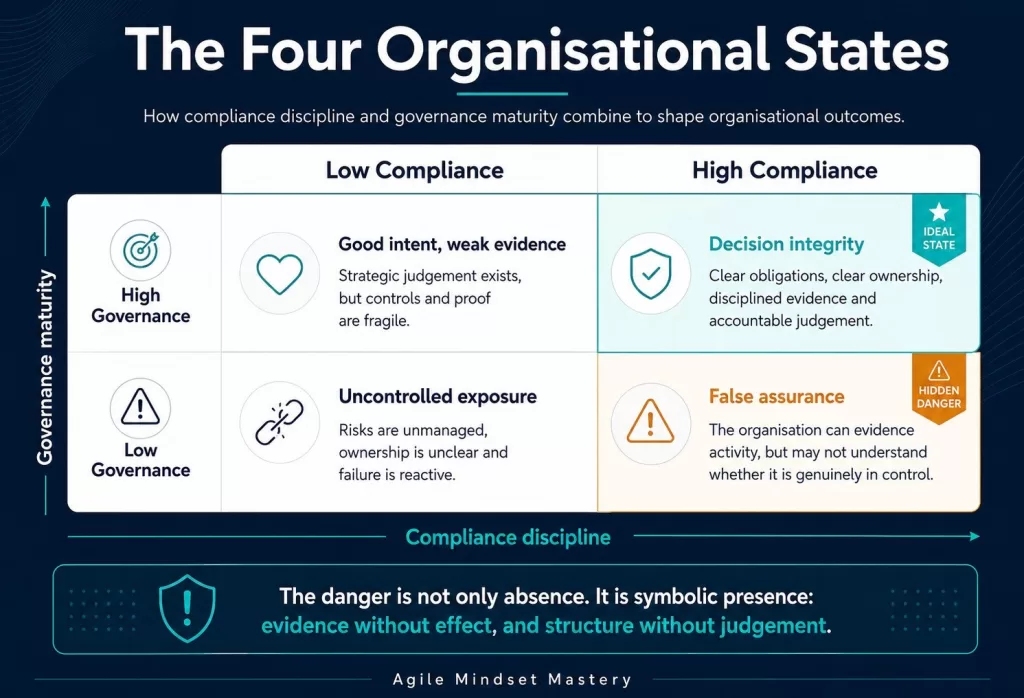
It is symbolic presence.
An organisation with no compliance discipline and no governance maturity is obviously exposed. Most leaders can see that. The risk is visible.
The more dangerous state is different.
It is the organisation with high compliance activity and low governance maturity.
This organisation has policies, controls, training, dashboards, registers, committees, assurance maps and reporting cycles. It can evidence a great deal. It may look mature from the outside.
But if judgement is weak, ownership is unclear, challenge is performative and decision logic is poorly understood, that evidence can become false assurance.
False assurance is dangerous because it calms the organisation before the risk is genuinely understood.
It says, “We have covered this.”
It says, “The process has been followed.”
It says, “The paper went to the committee.”
It says, “The board saw it.”
It says, “The audit was clean.”
But after a failure, the real question is rarely, “Did the organisation have documents?”
The real question is usually, “Why did the organisation believe those documents meant it was in control?”
Many organisational failures are not caused by the total absence of process. They are caused by misplaced confidence in process. After the event, investigations often find that risks were known, controls existed, committees met and reports were produced.
The failure sat in interpretation, escalation, ownership and judgement.
False assurance does not only create regulatory risk. It slows decisions, hides weak ownership, protects poor assumptions, increases rework, weakens trust and leaves leaders exposed when the organisation has to explain not only what happened, but why it believed it was safe.
The Four Organisational States
The relationship between compliance and governance can be understood as four organisational states.
The first is Uncontrolled Exposure: low compliance and low governance. Risks are unmanaged, ownership is unclear and failure is reactive. This is the obvious danger zone.
The second is Good Intent, Weak Evidence: high governance but low compliance. Leaders may have strategic judgement and a strong sense of purpose, but controls, evidence and repeatability are fragile. This can happen in entrepreneurial, mission-led or fast-moving environments where people believe they are doing the right thing but cannot consistently prove or sustain it.
The third is False Assurance: high compliance but low governance. This is the hidden danger zone. The organisation can evidence activity, but may not understand whether it is genuinely in control. It is strong on artefacts but weak on judgement.
The fourth is Decision Integrity: high compliance and high governance. Obligations are understood. Controls are real. Evidence is disciplined. Decisions are owned. Challenge is meaningful. Trade-offs are explicit. Learning loops are active.
That is the state worth aiming for.
Decision integrity is not bureaucracy. It is not more paperwork. It is not heavier governance for its own sake.
It is the ability to explain, under pressure, what was decided, who owned it, what evidence was used, what obligations applied, what trade-offs were accepted, what risks remained and how the organisation learned.
The test is not where the organisation believes it sits.
The test is what evidence supports that belief.
A leadership team that claims decision integrity should be able to show clear obligations, clear ownership, tested controls, recorded trade-offs, meaningful challenge and learning loops that change future decisions.
“Comply or explain” is a useful clue
The UK Corporate Governance Code is built around a “comply or explain” approach. The Financial Reporting Council makes clear that the Code does not operate as a rigid rulebook and that meaningful explanation matters when organisations depart from provisions.
That is important because it reinforces the distinction between compliance as mechanical conformity and governance as accountable judgement.
A poor organisation may treat “comply or explain” as a reporting requirement.
A mature organisation treats it as a discipline of reasoning.
If we comply, why is that appropriate?
If we do not comply, why is the alternative better in this context?
What evidence supports that judgement?
Who owns the decision?
How will stakeholders understand it?
How will we know whether it remains valid?
The FRC has also emphasised the value of meaningful explanations in corporate governance reporting, reinforcing the point that boilerplate language and generic statements are not the same as governance quality.
This is the heart of the issue. Governance is not demonstrated by the volume of words. It is demonstrated by the quality of explanation, ownership and judgement.
What this changes in the boardroom
This distinction matters because boards can easily receive assurance without receiving insight.
A board paper may describe risks, controls and mitigations. But if it does not explain decision logic, ownership, trade-offs, residual exposure and learning, the board may be informed without being properly enabled.
Board governance should not simply ask whether a paper has been reviewed.
It should ask what decision is required.
It should ask what is being recommended and why.
It should ask what alternatives were considered.
It should ask what trade-offs are being accepted.
It should ask who owns the decision after the meeting.
It should ask what evidence supports the recommendation.
It should ask what would cause the board to revisit the decision.
It should ask whether the organisation is learning, or simply reporting.
This does not mean boards should drift into operational detail. The board does not need to own every operational decision, but it does need to know whether the organisation’s decision system is working.
Papers should make trade-offs explicit.
Risk reports should show movement, not just status.
Owners should have authority, not just responsibility.
Minutes should capture decision logic, not just discussion.
Assurance should explain effectiveness, not merely activity.
That is how governance becomes more than architecture.
It becomes organisational intelligence.
What leaders should now ask
For boards and leadership teams, the practical question is not, “Do we have compliance and governance?”
Most organisations can answer yes to that.
The better question is:
Do our compliance and governance systems improve the quality of organisational judgement?
That question opens the right conversation.
Leaders should ask:
Where are we producing evidence without testing effectiveness?
Where are we holding meetings without improving decisions?
Where do we use common language without common understanding?
Where does accountability sit on paper but not in authority?
Where do risk owners lack the power to manage the risks they own?
Where are dashboards creating comfort rather than insight?
Where are we mistaking approval for understanding?
Where have we confused being defensible after the event with being intelligent before it?
Where has compliance been asked to compensate for weak governance?
Where has governance been used to legitimise decisions rather than improve them?
These are not compliance questions alone. They are governance questions.
More precisely, they are decision integrity questions.
The Opportunity
Getting compliance and governance right does not make an organisation slower.
Done well, it makes the organisation cleaner, faster and more trustworthy.
People understand the rules.
People understand the purpose behind the rules.
Decision rights are clearer.
Escalation is more meaningful.
Boards receive better information.
Committees have sharper purpose.
Evidence becomes more useful.
Risk discussions become more honest.
Learning becomes faster.
The organisation becomes less dependent on heroic individuals and more capable as a system.
That is the prize.
Compliance should not be reduced to the production of proof.
Governance should not be reduced to the performance of oversight.
The best organisations understand the difference and design for the relationship between them.
Compliance gives evidence its discipline.
Governance gives judgement its architecture.
Decision integrity is what happens when both are alive in the system.
The first step is not always to add more governance. It is to test whether the governance already in place is creating better judgement.
The future challenge for leaders is not simply to ask whether the organisation has complied, or whether something has been governed.
It is to ask a harder and more useful question:
Are we genuinely in control, or have we simply become fluent in the language of control?
Decision Integrity Workshop
The uncomfortable question for boards and leadership teams is not whether compliance and governance exist.
They almost always do.
The question is whether they are working as leaders believe they are working.
That is where the risk sits.
If the organisation uses words such as “owned”, “approved”, “controlled”, “assured” and “escalated” without testing whether those words mean the same thing in practice, then confidence may be building faster than control.
That is how false assurance takes root.
A focused Decision Integrity Workshop gives boards, executive teams, risk leaders, compliance leaders and internal audit leaders an external sense check on that gap.
The workshop examines where compliance activity may be mistaken for governance effectiveness, where common language may lack common understanding, and where decision ownership, evidence, challenge and judgement may not be as clear as the reporting suggests.
It tests whether decision language, ownership, evidence and authority are aligned across the people who rely on them.
The output is a clear view of where false assurance may exist, where decision language is misaligned, and what needs to change to strengthen decision integrity.
The aim is not to add bureaucracy.
It is to improve control, clarity and decision speed by testing whether the organisation is genuinely in control, or simply fluent in the language of control.
For any leadership team carrying significant risk, transformation, regulatory exposure or AI-enabled change, that is not a theoretical question.
It is a boardroom question.
A Decision Integrity Workshop helps boards, executive teams, risk, compliance and internal audit leaders test whether decision language, ownership, evidence and authority are truly aligned.
Test whether your organisation is genuinely in control, or simply fluent in the language of control.
It is one worth testing before events, regulators or failures test it for you.
Contact for further detailsRead more blog posts
17 Aug 2026
Perhaps the safest way to use AI is to learn how to disagree with it
AI can improve visible performance faster than the judgement supporting it. Emerging research suggests the effect depends partly on how much thinking people continue to do for themselves.

04 Mar 2026
High Consequence Decisions: How Decision Debt and Emotional Debt Create Exposure
What makes a decision truly high consequence? Discover how decision debt, emotional debt and time pressure combine to create exposure — and how to classify the moment before cost compounds.
Get in touch
We want to hear from you
If you're ready to break bias, decode decisions and unlock success, we're here to help. Let's get your transformation journey started!