
The Culture Exchange Matrix: How Leadership Behaviour Shapes Organisational Performance
Organisational culture is shaped by leadership behaviour. The Culture Exchange Matrix explains how behaviours shape outcomes and drive performance across every layer.
Share this article:
Culture, Carillion, and the Exchange That Failed
“The time is out of joint.”
William Shakespeare, Hamlet.
In Hamlet, the line is spoken when the order of the state has been disturbed. The system still stands, but it no longer holds its shape.
Most organisational failures do not begin with collapse. They begin with delay. Carillion did not run out of intelligence. It ran out of permission. By the time reality reached the boardroom intact, there was nothing left to do with it.
That is the part that often gets missed.
People knew. Margins were thin. Cash was fragile. Risk was accumulating faster than it was being spoken.
But across the system, a quiet lesson had already been learned. Reassurance travelled faster than truth. Confidence landed better than uncertainty. Bad news was safer when framed later.
No villains. No single catastrophic decision. Just rational behaviour in an unsafe exchange.
Boards asked for confidence. Executives supplied polish. Managers translated pressure into urgency. Teams stopped escalating what they could already see.
Culture did not fail dramatically. It failed politely.
This is why culture is not values, engagement scores, or statements of intent. Culture is the speed at which reality is allowed to move upward.
Every organisation is running a cultural exchange, whether it names it or not.
What is modelled in one layer becomes permission in the next. When that exchange is balanced, culture evolves. When it is not, delay sets in.
Below is the behaviour and outcome pattern that distinguishes organisations that learn early from those that learn late.
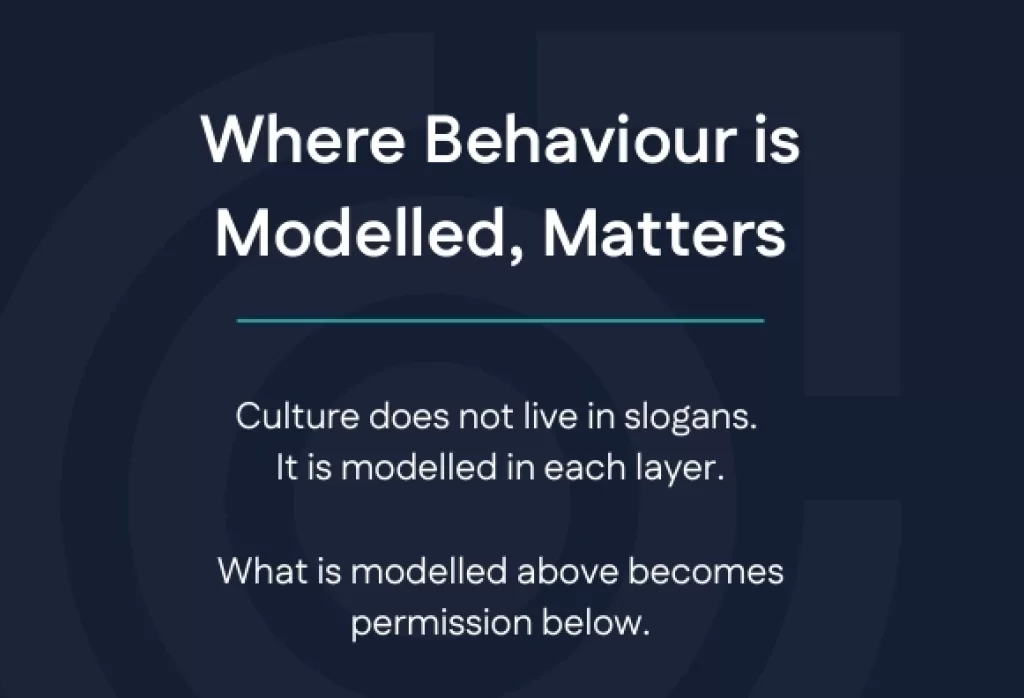
The Behaviour to Outcome Culture Exchange Matrix
Board
Behaviours
Ask for signal, not reassurance
Respond calmly to early discomfort
Challenge without theatre or punishment
Protect candour explicitly
Outcomes
Early visibility of risk
Fewer surprises
Executives who think rather than perform
Governance that steers rather than corrects
Executive Leadership
Behaviours
Name uncertainty plainly
Translate pressure into clarity, not urgency
Invite challenge before alignment
Own decisions without defensiveness
Outcomes
Trust from the board
Decisions that stick
Reduced escalation noise
Strategy that moves instead of circling
Senior Leaders and Managers
Behaviours
Create safety before demanding pace
Replace pressure with prioritisation
Coach judgement rather than compliance
Surface risk early and cleanly
Outcomes
Teams that self correct
Lower emotional load
More predictable delivery
Less dependency on control
Teams
Behaviours
Speak honestly about blockers
Treat mistakes as learning signals
Take responsibility for outcomes
Challenge ideas without personal threat
Outcomes
Psychological safety
Clear ownership and priorities
Faster adaptation
Sustained engagement and pride
When this exchange holds across layers, three things quietly become true.
Truth moves faster than fear.
Learning compounds instead of resetting.
Performance improves without being demanded.
This exchange does not improve through workshops or slogans. It improves when behaviour is modelled consistently at the top and reinforced calmly when tested.
Carillion is not a story about construction, outsourcing, or accounting. It is a story about what happens when reality is slowed by culture.
By the time the truth finally arrived intact, time was already out of joint.
Every board has the same choice.
To create a system where truth arrives early, while there are still options. Or one where it arrives late, when there are only consequences.
Culture does not announce itself when it changes. It reveals itself in what people decide what is safe to say, and when.
If the influence of a positive culture seems so obvious, so structural, and so powerful, why do organisations still get it so wrong?
And if the exchange can only be reset by what is modelled at the top, who is holding up the mirror when it matters most?
Culture rarely shifts through intention alone. It shifts when leaders are willing to examine the behaviours they are signalling, and redesign the exchange deliberately before time slips out of joint again.
Read more blog posts
19 May 2026
Is Coaching For Me? Blind Spots, Potential and What You May Be Leaving Behind
A private reflection to help you decide whether coaching could help you see blind spots, make better choices and unlock potential you may be leaving behind.

01 May 2026
South East Water and the Governance Risk Behind Operational Failure
South East Water’s leadership crisis shows how operational failures become governance failures when boards tolerate weak signals, delayed investment and repeated reassurance without visible progress.

29 Jul 2025
Mindset Is Your Operating System
Unlock leadership clarity, fix transformation bottlenecks, and overcome decision fatigue with mindset tools, emotional intelligence frameworks, and bias-aware systems—built for agile teams, waterfall programs, and high-pressure business environments.
Get in touch
We want to hear from you
If you're ready to break bias, decode decisions and unlock success, we're here to help. Let's get your transformation journey started!