
How Leaders Unblock Real Value Under Pressure
Why capable organisations stay busy while value stalls. A leadership lens on decision avoidance, bias, culture, and how reframing delivery as learning restores momentum.
Share this article:
When Progress Feels Busy but Nothing Moves
There is a particular kind of meeting that looks productive from the outside.
Slides are polished. Updates are thorough. Risks are acknowledged. Everyone agrees the work is important.
And yet, when the meeting ends, nothing meaningful has shifted. You know this because it felt exactly like the last meeting where the same issues and questions looped right round again.
No decision has truly closed. No assumption has been tested. No value has reached the people it was meant to serve. Just requests for more data, more feedback.
Most leaders have been in this room.
Many have chaired it.
What is rarely acknowledged is that this moment is not a delivery failure. It is a decision moment that quietly passed without being taken. And nobody asked why?
When Activity Replaces Value
When value stalls, the instinct is to blame pace, process, or prioritisation.
In practice, something more human is usually at work.
Delivering the smallest meaningful increment of value often feels riskier than continuing to prepare. Early delivery exposes thinking. It invites feedback. It makes judgment visible.
So work expands instead. That means timeframes expand too, deadlines stretch ,and budgets are traded like football cards in a '70s playground.
- Scope grows a little.
- Dependencies are named.
- Quality thresholds rise.
The organisation stays busy. Learning slows. Value? Well, it slowly erodes with the visible evidence of a shrinking revenue stream reported after the drought.
This is the pattern where movement is mistaken for progress.
It rarely announces itself.
It hides behind diligence, rigour, and good intent.
The Quiet Trade Being Made
What is really happening in these moments is a trade.
Certainty is being protected at the expense of learning.
- Early delivery creates feedback.
- Feedback creates judgement.
- Judgement creates exposure.
So value is delayed until it feels safer to share. By the time it is released, it arrives polished but late, complete but less useful than it could have been. Commercial windows missed, market share lost, and then, portfolio or corporate restructuring.
This is not because people do not understand principles. It is because understanding is not the constraint.
The constraint is what it feels like to be wrong in public.
The Biases and Anti-Patterns Beneath the Surface
What looks like a delivery problem here is more accurately a cognitive one.
Several biases and well-known organisational anti-patterns tend to converge in this moment, particularly under senior-level pressure.
Loss aversion plays a central role. The potential cost of visible failure or negative judgment is felt more strongly than the potential value of early learning. Protecting certainty feels rational, even when it delays progress.
Alongside this sits perfectionism, which reframes early delivery as recklessness rather than experimentation. Work is only considered safe once it appears complete, even if completeness adds little additional insight.
Effort justification then reinforces the pattern. Time, budget, and energy already invested begin to distort judgment about what should happen next. Continuing feels responsible. Stopping or simplifying feels wasteful.
Together, these biases stabilise a familiar anti-pattern: activity is rewarded, learning is deferred, and decisions quietly stall without being explicitly refused.
The reason this pattern persists is not capability.
It is these responses that feel sensible inside the system leaders are operating within.
Why This Pattern Persists at Senior Levels
At the leadership level, the cost of being visibly wrong can feel higher than the cost of being quietly slow, or making a mistake as part of controlled experimentation, learning, innovation and leading a market.
Leaders are often rewarded for confidence, composure, and control. Early delivery disrupts all three. It replaces certainty with perceived exposure.
Under pressure, many leaders unintentionally signal that surprises are dangerous, incomplete thinking is a liability, and mistakes should be avoided rather than surfaced.
Teams respond rationally to these signals.
- They delay value to protect credibility.
- They polish to avoid judgment.
- They optimise for agreement instead of insight.
Over time, organisations become very good at appearing rigorous while struggling to learn.
The Cost of Leaving It Unaddressed
The cost is rarely immediate.
It shows up gradually.
- Decisions take multiple cycles to close.
- Teams work harder but feel less effective.
- Activity metrics improve while impact remains unclear.
- Confidence erodes quietly, not dramatically.
Eventually, urgency arrives from outside.
By then, learning is expensive.
What could have been discovered safely through small releases and safe experiments now has to be resolved under pressure.
Reframing What Delivery Is For
The shift that unlocks progress is not about speed.
It is about permission.
Specifically, permission to treat delivery as learning rather than judgment.
The pivotal change is moving from asking:
"Is this ready?"
to asking:
"What would we learn if we released this now?"
When delivery is framed as an experiment rather than a verdict, behaviour changes.
- Small increments feel safer.
- Feedback becomes useful rather than threatening.
- Momentum starts to build.
This is not a process change.
It is a leadership signal.
What This Does to Culture
Culture does not shift because values are rewritten or workshops are run.
It shifts because what feels safe to do in moments of uncertainty changes.
In organisations caught in this pattern, safety is often conditional.
People feel safe when they appear prepared, certain, and complete.
When leaders signal that learning matters more than polish, safety becomes contextual instead. People feel safe when early signals are welcomed, incomplete thinking is allowed, and insight is treated as a contribution rather than a failure.
This quietly changes how meetings feel.
- Risks are raised earlier.
- Problems are named before they harden.
- Learning moves forward in time rather than being postponed until after something breaks.
Accountability becomes clearer rather than harsher.
Instead of arriving late through escalation or blame, it shows up early as shared sense making. Questions like "What did we learn?" and "What changed our view?" replace the need for post-mortems.
Over time, trust shifts.
Not towards those who appear most certain, but towards those who make their thinking visible and adapt quickly.
That is how momentum builds without pressure.
How This Helps Leaders
For leaders, this reframing restores leverage rather than removing control.
By treating delivery as learning, leaders receive better information sooner.
They reduce surprise, not increase risk.
Instead of carrying one large reputational moment at the end, risk is spread across many small learning moments.
Issues surface while they are still cheap to address.
Crucially, leaders stop becoming the bottleneck for certainty.
Teams no longer wait for perfection to be approved.
Decisions close faster.
Attention is freed for genuinely strategic work.
Leadership shifts from enforcing confidence to enabling clarity.
That is not a soft outcome.
It is a decisive advantage.
A Pause for Reflection
Think about the last piece of work that took longer than it should have.
Not the official reason.
The real one.
What would earlier delivery have exposed that you weren’t ready to deal with?
Let it land.
Because how leaders answer it, even silently, determines what their organisation can surface, learn, and change next.

Read more blog posts
06 May 2026
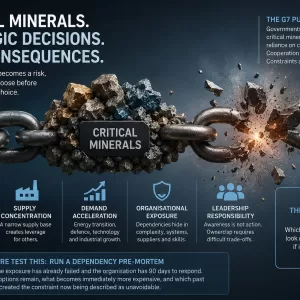
Critical Minerals and the Leadership Risk of Strategic Dependency
The G7’s critical minerals push reveals a boardroom issue beyond supply chains: organisations often tolerate known dependencies until events turn them into strategic constraints.
22 Jul 2026
Why Board Independence Is Not Enough During a Corporate Turnaround
Reports of a possible Diageo board reshuffle expose a wider governance tension. Independent directors may have permission to challenge, but effective oversight during a turnaround also requires enough sector knowledge to recognise which executive assumptions carry the greatest risk.
28 Apr 2026
Why Cost Pressure Is Really a Leadership Decision Problem
As geopolitical disruption drives costs higher and confidence lower, many organisations are moving into defensive control. The overlooked risk is not simply inflation or supply chain disruption, but the cumulative effect of delayed investment, paused hiring and narrowed executive judgement.

Get in touch
We want to hear from you
If you're ready to break bias, decode decisions and unlock success, we're here to help. Let's get your transformation journey started!