
When Good Leaders Make Decisions in a False Environment
Senior executives can make entirely rational decisions that still fail when the reality reaching them no longer reflects the organisation they are leading. What happens when good judgement is exercised in a false environment?
Share this article:
Good leaders can make poor decisions when reality is filtered. Explore how executive judgement, blind spots and independent challenge shape decisions.
What’s Happening
Some poor executive decisions make complete sense when you understand the environment in which they were made. The information supported the decision, the assumptions appeared reasonable, the executive team discussed the risks and the board asked appropriate questions. Nobody ignored an obvious warning and the governance process worked much as it was designed to work. Yet the decision was still wrong.
We tend to examine situations like these by looking for a failure in judgement. Perhaps the executive was overconfident, challenge was weak, the organisation moved too slowly or somebody failed to recognise something that, with hindsight, appears obvious. There is another possibility that deserves more attention. The judgement may have been entirely reasonable, but the environment in which it was exercised was not an accurate reflection of the organisation.
That does not require anybody to falsify information or deliberately conceal a problem. The distortion can be much quieter. Information is summarised as it travels, operational complexity is compressed, uncertainty is converted into actions and difficult realities acquire language that makes them manageable. By the time an issue reaches the most senior decision-makers, the individual facts may all be correct while the overall picture they create is incomplete.
I explored how that environment can form in Boardrooms: The Eye of the Storm. The central observation was that senior leadership can occupy a strangely calm position while considerable turbulence exists elsewhere in the organisation. Pressure from customers, markets, regulation and delivery converges towards the centre, but what eventually arrives has usually been translated. Dashboards replace stories, percentages replace consequences and operational difficulty arrives accompanied by commentary, ownership and reassurance.
Boardrooms: The Eye of the Storm
That translation is necessary. Senior teams could not function if every piece of operational noise arrived untouched. The difficulty begins when compression starts to change meaning. At that point, the eye of the storm becomes more than a metaphor for executive distance. It becomes a decision environment, and consequential decisions begin to be made from within it.
"There is established research behind the concern that seniority changes the information available to a leader."
What’s Being Said
There is established research behind the concern that seniority changes the information available to a leader. Hal Gregersen, writing in Harvard Business Review, describes the problem as the “CEO bubble”. His argument contains a difficult contradiction: the position that gives a chief executive the authority to change direction can also insulate that person from information capable of challenging the assumptions on which the existing direction depends. (Harvard Business Review)
Gregersen makes a particularly useful distinction between information actively travelling towards senior executives and information sitting elsewhere in the organisation or market. Reports, briefings and management conversations have already been selected and prepared by somebody. The uncomfortable signal that might materially alter an executive's interpretation of events may be found in the information that is not naturally travelling towards them at all. (Harvard Business Review)
Russell Reynolds reaches a similar conclusion in its work with CEOs. It describes an invisible bubble around the role in which leaders become further removed from what people genuinely think and experience. The organisation may still provide considerable amounts of information, but the leader can receive a more polished version of events and experience less direct challenge. Its work explicitly connects that isolation with blind spots affecting decision-making. (russellreynolds.com)
The problem becomes more significant under pressure. Research from Russell Reynolds on complex CEO decisions argues that high-stakes decisions increasingly have to be made with incomplete information, competing stakeholder expectations and no obvious answer. Its analysis suggests that curiosity and the willingness to examine a situation from different vantage points become particularly important because pressure can narrow that openness and make familiar answers more attractive. (russellreynolds.com)
That pressure has not reduced. In September 2026, Russell Reynolds described C-suite decision-making as involving more decisions, greater speed, incomplete information and less space to think. That combination matters because the executive may be receiving a highly processed version of organisational reality at precisely the point when the demands of the role make it harder to stop and interrogate that reality. (russellreynolds.com)
More information does not necessarily resolve this. A senior team can have excellent dashboards while sharing the same assumptions about what those dashboards mean. A board can challenge management rigorously while both are working from the same incomplete representation of events. The governance process can therefore appear disciplined and effective while the reality feeding that process has already been filtered.
"Every statement presented to the senior team can remain factually correct while the combined picture is wrong"
What I’ve Noticed
The more dangerous version of this problem is not the organisation where somebody is lying. It is the organisation where almost everything being reported is individually true.
Consider a senior team reviewing deteriorating customer service. The dashboard says service remains within agreed tolerances. Complaints have increased, but not dramatically. The operations director reports that additional controls are working, absence is slightly higher and a recovery programme remains amber. The executive team challenges the position and concludes that further intervention would be disproportionate. Management should continue with the recovery plan and report again next month.
Nothing about that decision is obviously weak. Now change the vantage point. Experienced employees may be manually correcting failures before customers encounter them. Managers may be carrying vacancies because admitting that the service cannot operate within its existing resources creates another problem. People may be working additional hours that never appear in the operating model. Some customers may have stopped complaining because previous complaints achieved little. The programme may remain amber because turning it red creates escalation, scrutiny and consequences.
Every statement presented to the senior team can remain factually correct while the combined picture is wrong. That is considerably harder to detect than dishonesty. A lie creates the possibility of discovery. A collectively constructed reality can feel completely credible because everybody contributing to it is reporting something they reasonably believe to be true.
The executive then makes a rational decision from within that environment.
This is where the Eye of the Storm argument becomes more consequential. The calm at the centre does not simply affect what leaders know. It affects the decisions they make with what they know.
Experience complicates this further. Senior leaders become good at filtering noise because they have to. They have seen supposedly critical problems disappear after competent intervention, watched alarming forecasts recover and learned that escalating every concern creates its own organisational dysfunction. Pattern recognition becomes part of executive judgement, and rightly so.
The difficulty is that familiarity can look remarkably similar to perspective. Something can stop alarming an executive because they understand it, but it can also stop alarming them because they have lived with it for too long. A missed target gains context, a recurring customer problem has an explanation, an operational workaround becomes how the organisation gets things done, and a delayed decision can wait another month because it has already waited six. The abnormal gradually loses its ability to attract attention.
That is how capable leaders can drift into weak patterns without experiencing themselves as drifting. The mechanisms are often the same ones that have helped them succeed. Experience creates pattern recognition, confidence and resilience, along with an ability to make difficult decisions without perfect information. Those are essential executive qualities, but they can also make an incomplete picture feel sufficiently complete.
"Decision quality begins earlier than the decision"
What This Means
Decision quality begins earlier than the decision. By the time options appear in an executive meeting, much of the intellectual architecture surrounding them already exists. The problem has been defined, evidence has been selected, certain explanations have become accepted, some information has travelled upwards and other information has not. Previous experience has influenced what feels significant and what appears familiar. Only then does the formal decision-making process begin.
That means asking whether a decision has been properly challenged may not go far enough. The environment supporting the decision also needs to withstand challenge. A senior team may need to understand what would have to be true for its preferred decision to be right, how confidently it knows those conditions actually exist, what people elsewhere are compensating for and what has become normal simply because the organisation has lived with it for too long.
These are not necessarily requests for another dashboard. They test whether the reality represented by the dashboard is sufficiently complete.
There is a personal executive dimension here that organisational process cannot entirely solve. The higher someone rises, the more complicated genuinely independent challenge becomes. Team members have responsibilities and reporting relationships. Boards have governance obligations. Advisers have briefs. Colleagues carry organisational history. Even candid conversations happen within a network of relationships and consequences.
The effect is visible in recent research. Russell Reynolds wrote in March 2026 that senior executives have access to more dashboards, analytics and information while becoming further removed from unfiltered truth. It also argued that the number of people able to challenge a leader without consequence diminishes with seniority. Its conclusion was made in the context of executive mentoring, but the underlying observation applies equally to the value of genuinely independent executive challenge. (russellreynolds.com)
This is where executive coaching becomes relevant in a more serious way than the familiar language of development and performance improvement suggests. An experienced executive does not necessarily need somebody outside the organisation telling them what decision to make. The more valuable contribution can be a confidential place in which to test the environment surrounding their judgement before testing the judgement itself.
That changes the nature of the conversation. An executive can examine why a particular interpretation feels so convincing, what evidence would cause them to change their mind and whether an assumption has survived because it remains valid or simply because it has been repeated often enough. Uncertainty can remain unresolved for long enough to be examined properly, without the immediate organisational requirement to turn it into a decision, recommendation or reassurance.
Independent challenge also matters because the executive is not simply an observer of the environment surrounding them. Their behaviour helps create it. People notice what attracts curiosity and what creates irritation. They learn how much evidence is required before raising an uncomfortable concern. They remember what happened when somebody challenged a strongly held position. An executive can sincerely invite candour while authority itself continues to influence what people are prepared to say.
This is why a question such as “Would I reach the same conclusion if I were experiencing this organisation from somewhere other than where I currently sit?” can be more valuable than another discussion about the options. It changes the vantage point before reinforcing the answer.
None of this removes accountability from the executive. It improves the conditions in which that accountability is exercised. Governance cannot compensate for a reality that never enters the governance process. Challenge cannot expose an assumption nobody recognises as an assumption. Excellent judgement cannot reliably overcome an environment that has quietly become more convincing than the organisation itself.
A good leader can therefore make a bad decision. A capable leadership team can collectively support it and a diligent board can approve it, with everyone involved behaving reasonably. Sometimes the failure begins before anybody makes the decision. It begins when the reality available to them is no longer sufficiently real.
"The Pressure Test"
Pressure Test
Take one consequential decision currently sitting with the senior team and, before asking again whether the decision itself is right, ask a different question: How confident are we that the environment in which we are making this decision accurately reflects the environment in which its consequences will be felt?
Hesitation or disagreement does not mean the proposed decision is wrong. It may reveal something more useful: the operating reality beneath the decision is not sufficiently shared. If that is the case, another round of debate about the options risks creating greater confidence in an unreliable picture.
The first response may therefore be to reconstruct the reality around the decision. That can mean making hidden operational compensation visible, surfacing conflicting interpretations, reconnecting customer consequences with operating constraints and identifying what has become so familiar that it no longer attracts challenge.
A good decision made in a false environment can still be the wrong decision. If this feels familiar, it is worth having the conversation before the numbers force it. Some leadership tensions are easier to resolve while they are still private.
If this feels familiar, or you recognise some of these symptoms around the decisions reaching your board, the Board Support Pathway creates space to examine how information, challenge, assumptions and organisational reality are shaping the quality of those decisions.
Explore Board SupportRead more blog posts
18 May 2026
LinkedIn Layoffs, UK Defence Cuts and the Hidden Risk of Hollowed-Out Organisations
LinkedIn’s reported workforce cuts and the UK military’s struggle to rebuild readiness reveal the same leadership warning: cuts can look successful for years before the loss of resilience becomes visible.
23 Dec 2025
The Lever Most Organisations Never Pull
Senior leaders are increasingly judged on cultural outcomes because culture now directly affects speed, margin, and delivery. Many performance problems surface first as emotional friction, hesitation, or distorted decision-making long before they appear in dashboards. This piece explores how working with emotion as leading data rather than lagging metrics, through a coaching and mentoring approach supported by practical tools, enables leaders to act earlier, make clearer decisions faster, reduce hidden drag, and regain control over outcomes they are already accountable for.
08 Jul 2025
Daily Lens: Why are CEOs leaving?
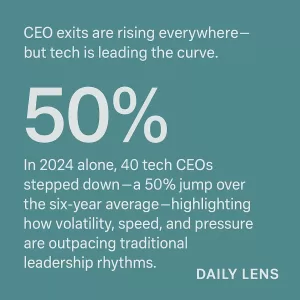
CEO's leaving the tech sector increases 50%. Exits aren't the problem, they're the signal
Get in touch
We want to hear from you
If you're ready to break bias, decode decisions and unlock success, we're here to help. Let's get your transformation journey started!