
British Steel Nationalisation: The Leadership Cost of Strategic Dependency
British Steel’s move towards public ownership reveals a wider boardroom problem: leaders often price efficiency more clearly than they price dependence, until the loss of capability becomes a strategic crisis.
Share this article:
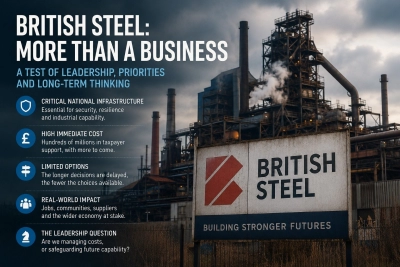
British Steel moving towards potential full public ownership after the UK government failed to secure a commercial sale that it considered acceptable for taxpayers.
What’s Happening
The UK government has announced new legislation that would give it a route to bring British Steel into public ownership, subject to a public interest test. The legislation is expected to be set out in the King’s Speech, with the government saying the test would consider national security, critical national infrastructure and wider economic support. The government had already intervened in April 2025 under the Steel Industry Special Measures Act to prevent a sudden halt in production at Scunthorpe. Since then, attempts to agree a commercial solution with British Steel’s owner have failed. (GOV.UK)
The financial pressure is significant. Reuters reports that taxpayer support for British Steel is projected to reach around £615 million by June 2026, while the Guardian has reported that a longer-term transition towards electric arc furnace production could require substantial additional support. (Reuters)
What’s Being Said
The government is framing the move as a question of sovereign capability, industrial resilience, national security and protection of UK steelmaking capacity. It argues that public ownership may be needed to avoid a sudden loss of production at Scunthorpe and to protect workers, suppliers and customers. (GOV.UK)
The criticism is focused less on the principle of intervention and more on the absence of a clear long-term answer. Commentators are asking what the end state is, how much more public money will be required, whether a future private buyer is realistic, and whether nationalisation becomes a bridge to renewal or simply an expensive holding pattern. (The Guardian)
What I’ve Noticed
The strongest signal here is about capital allocation under delayed pressure. Steel is a national example, but the leadership pattern is familiar in many organisations. A capability looks financially unattractive for years. Investment is deferred because the return is difficult to justify. The asset weakens. The dependency remains. Eventually the decision returns, but with fewer options and a much higher price.
Leaders often price efficiency more clearly than they price dependence. That is where boards can lose sight of risk. The cost of maintaining capability is visible, immediate and challengeable. The cost of losing capability is often theoretical until the moment it becomes operationally, politically or commercially unavoidable.
There is also an ownership problem. Once a capability is strategically important, it cannot sit ambiguously between finance, operations, procurement and risk. Someone has to own its resilience, not just its budget.
Have a question for The Boardroom Coach?
Message mePressure Test
Ask the executive team to name one capability, supplier, system or leadership dependency that currently looks financially unattractive but would become strategically critical if it disappeared. Then ask whether the board is treating it as a cost to reduce, a risk to monitor, or a capability to protect, transform and govern.
Read more blog posts
07 May 2026
Why UK Boards Must Treat Skills Succession as a Delivery Capacity Risk
Rising employment costs and ageing technical workforces are forcing UK boards to rethink succession planning. In delivery-led businesses, succession cannot stop at the leadership team. It must include the trades, craft and technical skills that make strategy executable.

06 May 2026
Critical Minerals and the Leadership Risk of Strategic Dependency
The G7’s critical minerals push reveals a boardroom issue beyond supply chains: organisations often tolerate known dependencies until events turn them into strategic constraints.
08 May 2026
What BP’s Reorganisation Reveals About Net Zero, Capital Allocation and Board Decision Making
BP’s restructuring is not evidence that UK net zero policy has changed. It is a sharper signal about the gap between policy ambition, investor pressure and corporate capital discipline.

Get in touch
We want to hear from you
If you're ready to break bias, decode decisions and unlock success, we're here to help. Let's get your transformation journey started!