
Does Age Make Us Wiser, or Just More Experienced?
What the science of judgement reveals about leadership, age discrimination and the environments in which good decisions are made.
Share this article:
We place considerable value on experience.
Board appointments frequently call for seasoned executives. Leadership roles demand evidence of previous success. Organisations invest heavily in identifying people who have accumulated the knowledge, expertise and judgement supposedly required to navigate complexity.
At the other end of the employment spectrum, younger candidates are frequently associated with adaptability, innovation and potential. Yet how much of this thinking is supported by evidence?
Does age actually improve judgement? Does experience make someone a better decision-maker? Are younger people naturally more adaptable? And perhaps most importantly, are organisations creating environments in which good judgement can develop and be exercised?
These questions matter because the assumptions we make about age, experience and capability influence who gets hired, who gets promoted, whose opinions are valued and who ultimately gets to make decisions.
They also reveal something uncomfortable.
Organisations may be selecting people for the characteristics they associate with good judgement without ever examining whether those people actually possess it.
And even when they do, the organisational environment may prevent that judgement from being exercised.
"Organisations may be selecting people for the characteristics they associate with good judgement without ever examining whether those people actually possess it."
The age and wisdom paradox
We tend to associate wisdom with age. It is a familiar assumption, reinforced through language, culture and organisational hierarchy.
Yet research suggests that the relationship is considerably weaker than we might expect.
A 2023 meta-analysis examining thirty years of psychological wisdom research reported an overall correlation between age and wisdom of just 0.04.
That is an extremely weak positive relationship.
In statistical terms, the corresponding shared variance is approximately 0.16%. It would be incorrect to interpret this as the proportion of wisdom caused by age, but it illustrates how little age alone tells us about an individual's wisdom.
Of course, wisdom is not a single, universally agreed characteristic. Researchers define and measure it in different ways, including perspective-taking, intellectual humility, recognition of uncertainty and the capacity to navigate complex social situations.
And that distinction matters.
In a 2010 study published in the Proceedings of the National Academy of Sciences, Igor Grossmann and colleagues found that older adults demonstrated stronger wisdom-related reasoning when examining social conflicts.
They were more likely to recognise uncertainty, consider different perspectives and acknowledge that circumstances might change.
These findings are not necessarily contradictory.
The broader meta-analysis suggests that age is a poor general predictor of wisdom. The earlier study suggests that particular components of wise reasoning may improve with age.
The important question, therefore, is not whether older people are wiser. It is which capabilities develop with age, which deteriorate and what influences the difference.
That question take us somewhere condsiderably more useful thatn another debate about generations.
"Sound judgement requires more than the ability to draw upon experience. It requires the willingness to question whether that experience remains relevant."
Experience is not the same as judgement
Cognitive ageing research has long distinguished between fluid and crystallised intelligence.
Fluid intelligence concerns our ability to process unfamiliar information, solve novel problems and manipulate information in working memory.
Crystallised intelligence reflects accumulated knowledge, learned concepts and expertise developed through experience.
These capabilities do not follow identical trajectories.
Processing speed and several fluid cognitive abilities generally decline across adulthood, although there is considerable variation between individuals.
Accumulated knowledge and expertise can remain stable or continue developing much later in life.
This creates an interesting tension.
An experienced executive may recognise patterns that a less experienced colleague may overlook. They may understand how apparently sensible decisions can produce unintended consequences. They may recognise familiar organisational behaviours or identify weaknesses in a proposed strategy.
But experience can also become a liability.
The executive who has successfully navigated five previous transformations may approach the sixth with considerable confidence.
What happens if the sixth is fundamentally different?
What happens when the patterns that previously produced success are no longer relevant?
Experience may help us recognise what we have seen before.
It does not necessarily help us recognise when what we are seeing is different. This is where cognitive flexibility becomes important.
Sound judgement requires more than the ability to draw upon experience. It requires the willingness to question whether that experience remains relevant.
A person who has spent thirty years reinforcing the same assumptions has not necessarily developed thirty years of increasingly sophisticated judgement.
They may simply have become more confident in those assumptions.
Conversely, someone with less experience who consistently examines evidence, considers alternatives and reflects on mistakes may develop stronger decision-making habits.
Age provides opportunities for learning.
It doesn’t guarantee that learning takes place.
"The capabilities required for sound judgement do not all improve or deteriorate together."
Some decision-making capabilities actually improve with age
There is another finding that challenges conventional assumptions.
Research into the sunk cost fallacy suggests that older adults may be less susceptible to certain forms of irrational commitment.
The sunk cost fallacy occurs when people continue investing in a failing course of action because of resources already committed.
Consider a board that has invested several million pounds in a transformation programme.
The evidence increasingly suggests that the programme will not deliver its intended benefits.
Yet the board continues investing because abandoning the programme would mean acknowledging that the original investment cannot be recovered.
The decision becomes influenced by what has already been spent rather than what can reasonably be achieved.
Research reviewed by Strough, Bruine de Bruin and Peters (2015) suggests that older adults can demonstrate greater resistance to sunk costs than younger adults.
This does not mean older people are generally less biased.
Different cognitive biases follow different patterns, and some decision-making tasks become more difficult with increasing cognitive demands.
However, the findings challenge the idea that declining processing speed necessarily translates into declining decision quality.
Indeed, a 2020 longitudinal investigation of decision-making competence found that applying decision rules and resistance to sunk costs remained relatively stable among adults aged 60 to 85 over five years, although resistance to framing showed a small decline.
The wider implication is important.
The capabilities required for sound judgement do not all improve or deteriorate together.
An organisation that equates age with cognitive decline may overlook valuable capabilities.
An organisation that equates seniority with wisdom may overlook significant weaknesses.
Both are making assumptions where evidence is required.
"An organisation can employ intelligent, experienced people while creating conditions that prevent them from exercising their judgement."
The environment in which judgement develops
There is a more fundamental question.
If age and experience do not automatically produce sound judgement, what does?
Part of the answer may lie in the environment in which people work, learn and make decisions.
In 1999, Amy Edmondson published influential research into psychological safety and learning behaviour in work teams.
Psychological safety describes a shared belief that people can take interpersonal risks without fear of humiliation or punishment.
Those risks include admitting mistakes, asking questions, expressing uncertainty and challenging established thinking.
Edmondson's research connected psychological safety with team learning behaviours.
But psychological safety alone is not enough.
An organisation can be comfortable, supportive and agreeable while remaining intellectually unchallenging.
People may feel perfectly safe expressing opinions because those opinions rarely differ.
The real test comes when someone challenges an established position, particularly one held by a powerful individual.
Imagine a senior leadership meeting.
The CEO presents a strategic decision.
One executive believes the underlying assumptions are flawed.
They have evidence suggesting the proposed direction may be wrong.
What happens next?
Does the executive raise the concern?
Does the CEO welcome the challenge?
Does the team examine the evidence?
Or does the executive remain silent because previous experience has taught them that disagreement carries consequences?
Now consider what happens when that experience is repeated over several years.
People learn which questions are safe to ask.
They learn whose opinions carry weight.
They learn whether uncertainty is interpreted as thoughtful caution or weakness.
They learn whether challenging authority is valued or punished.
Eventually, those lessons influence how people participate in decisions.
An organisation can employ intelligent, experienced people while creating conditions that prevent them from exercising their judgement.
This distinction between possessing a capability and being able to exercise it is crucial.
And it suggests that organisational culture may influence not only the quality of current decisions but also the development of future decision-makers.
"What matters is not simply what someone experiences, but what the environment allows them to learn from that experience."
When dissent becomes a liability
Constructive dissent is particularly important.
A dissenting perspective can expose assumptions that others have overlooked. It can introduce contradictory evidence, reveal alternative interpretations and challenge premature consensus.
But dissent creates friction.
It interrupts the comfortable progression towards agreement.
And in environments where conformity is rewarded, the person raising the challenge can become the problem.
Rather than examining the evidence, attention shifts towards the individual.
They are described as difficult, negative, resistant or insufficiently aligned.
The organisation may believe it is protecting cohesion.
In reality, it may be suppressing one of the mechanisms through which collective judgement improves.
This creates a potentially damaging cycle.
Dissent is discouraged.
Alternative perspectives become less visible.
Decisions receive less scrutiny.
Confidence increases because disagreement decreases.
Yet the apparent consensus may reflect silence rather than genuine agreement.
There is an important distinction between a team that agrees because it has examined the alternatives and a team that agrees because challenging the prevailing view feels unsafe.
They can look remarkably similar from the boardroom table.
The difference becomes apparent when circumstances change.
The conditions for developing judgement
The research suggests several conditions worth examining together.
Psychological safety allows people to express uncertainty and challenge assumptions.
Constructive dissent introduces competing perspectives.
Intellectual humility encourages recognition of the limits of one's knowledge.
Reflective practice creates opportunities to learn from experience.
Accountability encourages individuals to explain and examine the reasoning behind decisions.
Cognitive diversity broadens the perspectives available for consideration.
These conditions should not be treated as a scientifically validated formula guaranteeing better judgement.
They are, however, supported by related strands of research and provide a credible basis for examining how organisations develop and exercise decision-making capabilities.
Crucially, they also suggest that experience alone is insufficient.
What matters is not simply what someone experiences, but what the environment allows them to learn from that experience.
Solomon's Paradox: Why capable leaders struggle with their own decisions
There is another dimension to judgement that is particularly relevant to senior leadership.
In 2014, psychologists Igor Grossmann and Ethan Kross investigated a phenomenon known as Solomon's Paradox.
King Solomon was renowned for his wisdom when judging the problems of others, yet his personal decisions did not always demonstrate equivalent wisdom.
The researchers examined whether people reason more wisely about other people's problems than their own.
Across three experiments involving 693 participants, they found evidence that people demonstrated greater wisdom-related reasoning when considering another person's relationship difficulties than when considering their own.
Importantly, the researchers found that adopting a psychologically distanced perspective could eliminate this difference in the experimental conditions studied.
The effect was observed across younger and older adults.
The findings were published in Psychological Science.
Consider the implications for executive leadership.
A CEO may be exceptionally capable of recognising flawed strategy, poor leadership behaviour or organisational dysfunction when examining another business.
They may offer insightful advice to fellow executives.
They may identify weaknesses that others have overlooked.
Yet when similar circumstances arise within their own organisation, their judgement can become entangled with personal investment.
Their reputation may be involved.
Their previous decisions may be implicated.
Their relationships may influence how they interpret events.
Their professional identity may be challenged.
The problem is no longer simply analytical.
It has become personal.
The leader may not lack judgement. They may struggle to access and apply it objectively when they are personally involved.
This is the central relevance of Solomon's Paradox.
And it raises an important question.
If experienced leaders can reason more wisely about other people's problems than their own, what helps them create sufficient distance to examine their own decisions?
"The leader may not lack judgement. They may struggle to access and apply it objectively when they are personally involved."
The value of independent executive coaching
This is where independent executive coaching becomes particularly relevant.
Not because the coach necessarily possesses greater expertise than the executive.
Not because the executive needs someone to make decisions for them.
And certainly not because experience or seniority has somehow failed.
The value lies in creating the conditions for structured reflection, independent challenge and psychological distance.
Imagine a CEO struggling with a member of their leadership team.
They believe the individual is resisting change.
They are frustrated by what they perceive as a lack of commitment.
A conventional conversation might focus immediately on how to manage the individual's performance.
An independent coaching conversation can explore something different.
What evidence supports the CEO's interpretation?
What assumptions are being made about the individual's intentions?
How might the other person describe the situation?
What evidence would cause the CEO to reconsider?
What might the CEO's own behaviour be contributing?
And perhaps most revealingly:
If another CEO brought this situation to you, what advice would you give them?
That final question introduces psychological distance.
It invites the executive to examine the problem from a position less dominated by their immediate emotional involvement.
The research into Solomon's Paradox supports the potential value of this shift in perspective.
It does not, by itself, establish that executive coaching produces equivalent effects or improves organisational decision outcomes. Those are separate propositions requiring their own evidence.
Nevertheless, the connection offers a credible theoretical foundation for a judgement-focused coaching approach.
Independence must be more than a contractual arrangement
There is another important consideration.
Senior executives often have access to experienced advisers.
They have colleagues, board members, professional networks and internal leadership teams.
Yet those relationships operate within particular organisational and personal contexts.
An internal adviser may be concerned about challenging someone who influences their career.
A colleague may share the same assumptions.
A board member may have supported the original decision.
An external consultant may have a commercial interest in a particular outcome.
An independent executive coach can provide a different relationship.
One in which the executive has space to examine uncertainty, acknowledge concerns and reconsider assumptions without immediately managing the organisational consequences of those disclosures.
But independence is not guaranteed simply because someone operates outside the organisation.
A coach who continually agrees with the executive, avoids difficult questions or prioritises maintaining the commercial relationship may offer reassurance without meaningful challenge.
The value of independent coaching depends partly on the coach's willingness and ability to challenge the thinking of the person engaging them.
This is an important distinction.
The objective is not to make the executive feel consistently right.
It is to help them think more effectively.
For executives seeking structured development of their judgement and leadership capability, the Leadership Actualisation Pathway provides an opportunity to examine real leadership situations, challenge assumptions and translate reflection into deliberate action.
The starting point is not an assumption that the executive needs fixing. It is an examination of what their responsibilities, decisions and circumstances now require.
What does this mean for age discrimination?
The relationship between age and judgement has implications beyond leadership development.
It challenges assumptions that influence recruitment, promotion, succession planning and workplace inclusion.
Age discrimination is often discussed primarily as a question of fairness.
It is that.
But it may also be a question of organisational capability.
In 2012, Thomas Ng and Daniel Feldman published a major meta-analysis examining six common stereotypes about older workers.
The research drew on 418 studies involving more than 208,000 participants.
The researchers found that five of the six stereotypes were not supported by the aggregated evidence.
These included assumptions that older workers were generally less motivated, more resistant to change and less trusting.
The one stereotype receiving support concerned lower willingness to participate in training and career development activities. That finding should not be confused with an inability to learn or develop.
The research, published in Personnel Psychology, challenges several familiar assumptions about older employees.
Ng and Feldman, Evaluating Six Common Stereotypes About Older Workers
Consider how these assumptions appear in everyday organisational language.
We need someone with more energy.
We're looking for fresh thinking.
They might struggle with the pace of technological change.
We want somebody who can grow with the business.
They're probably too established in their ways.
None of these statements necessarily describes an individual's actual capabilities.
They may simply reflect assumptions associated with age.
The problem is not that adaptability, energy, curiosity or technological competence are irrelevant.
They may be essential requirements.
The problem arises when organisations infer those characteristics from age rather than assessing them directly.
If adaptability matters, assess adaptability. If critical thinking matters, assess critical thinking. If judgement matters, assess judgement.
Age is not an adequate substitute.
"If adaptability matters, assess adaptability. If critical thinking matters, assess critical thinking. If judgement matters, assess judgement."
Age discrimination is also a governance concern
Age is a protected characteristic in employment law, although the legislative framework differs between Great Britain and Northern Ireland.
In Great Britain, the Equality Act 2010 prohibits unlawful age discrimination in employment, including recruitment and development opportunities. Certain forms of age-related treatment can be legally justified in specific circumstances.
Northern Ireland has separate protections under the Employment Equality (Age) Regulations (Northern Ireland) 2006, as amended.
The Advisory, Conciliation and Arbitration Service and the Equality Commission for Northern Ireland provide guidance on these obligations.
But legal compliance should be the starting point, not the limit of organisational responsibility.
Boards should also be concerned about the consequences of relying on untested assumptions when selecting and developing people.
If age influences who receives opportunities, it may also influence which knowledge, experiences and perspectives become available to the organisation.
The organisational cost of age discrimination
When organisations favour particular age groups, they influence the experience, knowledge and perspectives available within their workforce.
An organisation that systematically excludes older candidates may lose access to valuable expertise, institutional knowledge and familiarity with previous organisational challenges.
An organisation that disproportionately favours seniority may overlook emerging perspectives, new technical capabilities and alternative approaches.
Neither approach guarantees better decisions.
The more important question concerns the capabilities and perspectives available to the organisation and whether those perspectives are genuinely considered.
There is also a less visible possibility.
Age discrimination may influence whether people feel able to contribute.
An experienced employee who repeatedly hears that the organisation wants younger, more dynamic thinking may become reluctant to challenge established decisions.
They may withdraw from discussions.
They may stop volunteering alternative perspectives.
They may conclude that their contribution is no longer valued.
Their knowledge has not necessarily disappeared.
Their capacity for judgement may remain intact.
But the organisation may no longer benefit from it.
This is a plausible mechanism connecting age-related exclusion with psychological safety and collective decision-making. It should be investigated rather than assumed to occur universally.
Nevertheless, it raises an uncomfortable possibility.
Organisations may lose access to valuable judgement long before they lose the people who possess it.
Age discrimination therefore deserves examination not only through the lens of employment fairness but also through the lens of organisational decision integrity.
"Organisations may lose access to valuable judgement long before they lose the people who possess it."
The boardroom problem: Are we appointing experience or judgement?
The implications become particularly interesting at board level.
Boards understandably value experience.
Non-executive directors are expected to bring independent judgement, strategic understanding, governance expertise and the ability to challenge executive thinking.
Yet how frequently are those capabilities assessed directly?
A distinguished career may demonstrate substantial achievement.
It may indicate valuable expertise.
It may suggest familiarity with complex organisational decisions.
But it does not automatically establish intellectual humility, cognitive flexibility or the willingness to challenge prevailing assumptions.
Nor does it establish that someone can recognise when their own experience is no longer relevant.
A board composed entirely of highly experienced individuals may still demonstrate poor collective judgement.
Members may share similar professional backgrounds.
They may interpret evidence through familiar assumptions.
They may defer to one another's perceived expertise.
They may avoid challenging a respected colleague.
Their collective experience may reinforce confidence without necessarily improving scrutiny.
Equally, appointing individuals with different backgrounds or ages does not automatically produce better decisions.
Diversity introduces the possibility of different perspectives.
The organisation must still create the conditions in which those perspectives can be expressed, examined and integrated.
The central question is therefore not simply how much experience sits around the boardroom table.
It is whether that experience is being subjected to sufficient independent examination.
This is where board effectiveness, psychological safety, constructive dissent and decision discipline begin to converge.
For chairs and boards, the Board Support Pathway provides a structured opportunity to examine collective judgement, constructive challenge and the assumptions influencing governance and significant decisions.
"A board composed entirely of highly experienced individuals may still demonstrate poor collective judgement."
From leadership behaviour to decision integrity
If organisations want to improve judgement, they need to move beyond assumptions about individual capability.
They must also examine how decisions are made.
What happens when a significant decision is proposed?
Are the underlying assumptions made explicit?
Is contradictory evidence actively sought?
Are alternative courses of action genuinely considered?
Can people challenge the prevailing view without personal consequences?
Is uncertainty acknowledged?
Are decisions reviewed when new evidence emerges?
And perhaps most importantly, can the organisation distinguish between a good decision that produces an unfortunate outcome and a poor decision that happens to succeed?
That distinction is fundamental.
A successful outcome does not necessarily demonstrate good judgement.
A decision may succeed because of favourable circumstances, incomplete information or simple luck.
Equally, a carefully reasoned decision may produce an unsuccessful outcome because events develop in ways that could not reasonably have been anticipated.
If organisations judge decision quality exclusively through outcomes, they risk rewarding poor processes that happen to succeed while discouraging sound reasoning that encounters unfavourable circumstances.
This is the principle underpinning Decision Integrity within Agile Mindset Mastery.
The objective is to examine the quality of the thinking and processes through which decisions are reached, not simply the results that follow.
The role of The Boardroom Charter
There is a practical starting point.
Before introducing sophisticated decision-making frameworks, leadership teams need shared expectations about how they will work together.
How will they handle disagreement?
What happens when someone challenges a decision?
How will uncertainty be expressed?
What responsibilities do leaders have to examine their own assumptions?
How will the team hold itself accountable?
The Boardroom Charter provides a practical mechanism for establishing shared behavioural commitments.
It is deliberately intended to be accessible rather than bureaucratic.
But the Charter is not, by itself, a guarantee of decision integrity.
The Charter establishes the expectations. Decision Integrity examines whether those expectations are reflected in actual decisions.
That distinction matters because organisations are often better at describing their values than demonstrating them.
A leadership team may sincerely agree to welcome challenge.
The real test comes when someone challenges the CEO.
A board may declare its commitment to independent thinking.
The real test comes when a director questions a proposal supported by the majority.
Judgement is not demonstrated by the existence of a policy or statement.
It is demonstrated through behaviour.
Where leadership teams are uncertain about the causes of recurring problems, decision patterns or organisational friction, Diagnostic Discovery provides a means of examining the evidence before deciding what intervention, if any, is justified.
"Judgement is not demonstrated by the existence of a policy or statement.
It is demonstrated through behaviour."
Developing judgement rather than assuming it
The research examined throughout this article suggests that judgement should be treated as a capability requiring deliberate attention.
Not simply something acquired through age.
Not automatically conferred by seniority.
Not guaranteed by qualifications or previous success.
And not adequately assessed through confidence or personal reputation.
This creates an opportunity to reconsider leadership development.
Rather than focusing exclusively on knowledge acquisition, organisations could place greater emphasis on how individuals examine evidence, recognise uncertainty, respond to challenge and revise their conclusions.
At an individual level, this may involve structured reflection, cognitive bias awareness and the development of greater intellectual humility.
At a team level, it may involve establishing the behavioural conditions for constructive dissent and collective examination.
At board level, it may involve more deliberate scrutiny of assumptions, decision processes and the quality of independent challenge.
Within Agile Mindset Mastery, these questions inform the development of tools and approaches including the Agile Bias Detector, Cognitive Agility Matrix and Decision Integrity methodology.
They also inform ongoing work exploring how judgement might be developed and assessed through realistic decision simulations.
These tools should not be confused with independently validated measures of judgement simply because they draw upon established psychological research.
Their value must ultimately be demonstrated through appropriate application, testing and evidence.
That is an important principle.
A proposition concerned with decision integrity must be willing to subject its own assumptions to the same scrutiny it asks of others.
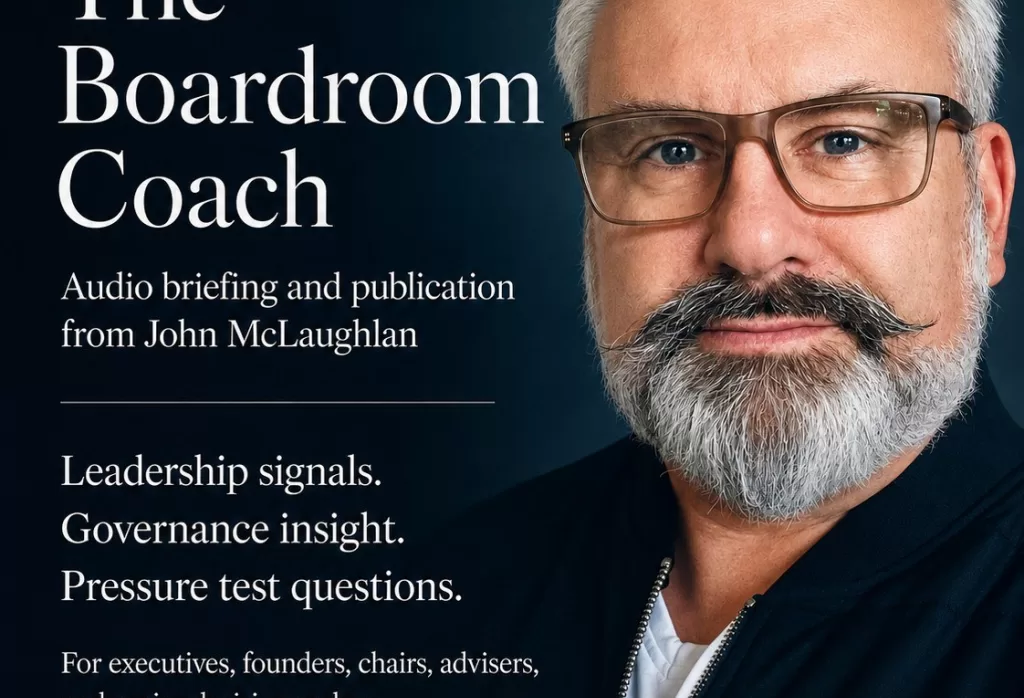
The role of The Boardroom Coach
My work as The Boardroom Coach sits at the intersection of these questions.
It draws upon experience across organisational transformation, executive leadership, governance and coaching, alongside continuing research into human judgement, cognitive bias and organisational behaviour.
The objective is not to provide executives with another collection of leadership slogans.
Nor is it to position coaching as a substitute for executive expertise.
It is to create opportunities for leaders and boards to examine how they think, how they make decisions and how their organisational environments influence those processes.
Through independent executive coaching, the focus is on developing reflective capability, examining assumptions and creating space for considered judgement.
Through board and non-executive support, the emphasis extends to independent challenge, governance and collective decision-making.
Through organisational Discovery and Decision Integrity work, the focus moves towards the conditions, behaviours and processes through which judgement is exercised.
These are connected challenges.
A highly capable executive may struggle to examine their own assumptions.
A leadership team may possess considerable collective expertise while suppressing dissent.
A board may have extensive experience without sufficiently challenging its established thinking.
And an organisation may inadvertently exclude valuable capabilities through assumptions about age, seniority or professional background.
The response cannot simply be more experience, more information or greater confidence.
It requires a more deliberate examination of judgement itself.
The question organisations should be asking
Perhaps the most important conclusion from the research is that we have been asking the wrong question.
We ask whether someone has enough experience.
We ask whether they have held sufficiently senior positions.
We ask whether they have demonstrated confidence and authority.
We sometimes make assumptions about their adaptability or potential based on age.
But these are not reliable substitutes for examining the quality of someone's judgement.
The evidence suggests that some cognitive capabilities change with age, while others remain stable or develop.
It suggests that experience can support wise reasoning without guaranteeing it.
It demonstrates that people can reason differently about their own problems and those of others.
And it indicates that organisational environments influence whether people feel able to question, challenge and learn.
Together, these findings point towards a different understanding of leadership capability.
Sound judgement is not simply something people possess. It is something they must continually exercise, examine and develop.
Organisations have a responsibility to create the conditions in which that can happen.
Leaders have a responsibility to remain open to challenge.
Boards have a responsibility to distinguish independent judgement from collective confidence.
And those responsible for recruitment, promotion and succession planning should be careful not to confuse age or seniority with the capabilities they are actually seeking.
Because experience is valuable.
But experience without reflection can reinforce assumptions.
Confidence without challenge can become overconfidence.
Agreement without dissent can conceal uncertainty.
And seniority without intellectual humility can create authority without wisdom.
The question is no longer simply whether age makes us wiser.
It is whether we are creating the conditions in which wisdom can develop, survive and influence the decisions that matter.
"Sound judgement is not simply something people possess. It is something they must continually exercise, examine and develop."
"Are we creating the conditions in which wisdom can develop, survive and influence the decisions that matter?"
A question for leaders and boards
If your organisation cannot reliably infer judgement from age, experience or seniority, how is it identifying, developing and protecting that capability?
And when was the last time your own thinking was subjected to genuinely independent challenge?
As The Boardroom Coach, I work with executives, leadership teams and boards to examine these questions through independent coaching, structured Discovery and approaches to Decision Integrity.
The starting point is the situation you face, not a predetermined intervention.
Explore the Agile Mindset Mastery engagement pathways, or arrange an initial conversation to establish what the evidence suggests is needed.
Research references
Dong, M., Weststrate, N. M. and Fournier, M. A. (2023). ‘Thirty Years of Psychological Wisdom Research: What We Know About the Correlates of an Ancient Concept’. Perspectives on Psychological Science, 18(4), pp. 778–811. DOI: 10.1177/17456916221114096.
Edmondson, A. (1999). ‘Psychological Safety and Learning Behaviour in Work Teams’. Administrative Science Quarterly, 44(2), pp. 350–383. DOI: 10.2307/2666999.
Grossmann, I. et al. (2010). ‘Reasoning About Social Conflicts Improves Into Old Age’. Proceedings of the National Academy of Sciences, 107(16), pp. 7246–7250. DOI: 10.1073/pnas.1001715107.
Grossmann, I. and Kross, E. (2014). ‘Exploring Solomon's Paradox: Self-Distancing Eliminates the Self-Other Asymmetry in Wise Reasoning About Close Relationships in Younger and Older Adults’. Psychological Science, 25(8), pp. 1571–1580. DOI: 10.1177/0956797614535400.
Ng, T. W. H. and Feldman, D. C. (2012). ‘Evaluating Six Common Stereotypes About Older Workers with Meta-Analytical Data’. Personnel Psychology, 65(4), pp. 821–858. DOI: 10.1111/peps.12003.
Del Missier, F., Hansson, P., Parker, A. M., Bruine de Bruin, W. and Mäntylä, T. (2020). ‘Decision-Making Competence in Older Adults: A Rosy View From a Longitudinal Investigation’. Psychology and Aging, 35(4), pp. 553–564. DOI: 10.1037/pag0000443.
Strough, J., Bruine de Bruin, W. and Peters, E. (2015). ‘New Perspectives for Motivating Better Decisions in Older Adults’. Frontiers in Psychology, 6, Article 783. DOI: 10.3389/fpsyg.2015.00783.
Find out more about The Boardroom Coach.
Email The Boardroom CoachRead more blog posts
04 Jun 2026
How to Recognise When Your Organisation Is Filtering Out Challenge
When challenge gets filtered out, the symptoms rarely appear in the meeting. They show up later as delayed delivery, private disagreement, customer friction and decisions that become harder to execute than they were to approve.

16 Sept 2026
When Good Leaders Make Decisions in a False Environment
Senior executives can make entirely rational decisions that still fail when the reality reaching them no longer reflects the organisation they are leading. What happens when good judgement is exercised in a false environment?
27 May 2026
BP’s Chair Removal Reveals the Governance Risk Hidden in Forceful Leadership
BP’s removal of Albert Manifold is more than a leadership shake-up. It reveals how organisations under pressure can confuse pace, force and control with strong governance.
Get in touch
We want to hear from you
If you're ready to break bias, decode decisions and unlock success, we're here to help. Let's get your transformation journey started!