
Organisational Risk: The Dependencies Boards May Overlook
How well do Boards understand organisational dependencies? Explore what cybersecurity, pension investments and FCA findings reveal about risk and assurance.
Share this article:

Brief from The Boardroom Coach
Edition 3 | 25 October 2026
1. The Boardroom Brief
Who Understands What Your Organisation Really Depends On?
Most organisations know who is responsible for what.
But knowing where responsibility sits is not quite the same as understanding everything the organisation depends upon.
Three developments this week, spanning cybersecurity, pension investments and financial regulation, offer a useful way to examine that distinction.
They concern different risks, operating in different environments. What connects them is a question about how organisations recognise exposures that extend beyond individual responsibilities.
A vulnerability you might never have heard of
On 21 October, the PHP development team released security updates addressing two critical vulnerabilities that could allow unauthenticated attackers to execute code remotely in affected configurations.
PHP is widely used to power websites and online applications. Many organisations rely upon it, directly or through services they purchase.
The technical details matter to those responsible for maintaining affected systems. But the leadership question is different.
If a critical vulnerability emerges in technology your organisation relies upon, how quickly can you establish whether you are exposed, what business operations might be affected, who is responsible for remediation and whether the necessary action has been completed?
A Board does not need to understand the internal workings of PHP.
It does need confidence that the organisation can identify critical dependencies and respond when those dependencies become a source of risk.
The distinction is between allocating responsibility for cybersecurity and having evidence that material exposures can be discovered and managed.
Diversified on paper. Exposed in practice?
On 22 October, The Pensions Regulator warned trustees about hidden concentration risks associated with artificial intelligence.
The concern was that portfolios appearing diversified across different investments could nevertheless share exposure to the same underlying AI-related market risks.
The regulator encouraged trustees to examine portfolios as a whole, consider direct and indirect exposures and test how investments might behave under different market conditions.
This is not a cybersecurity issue, and the mechanisms are different.
But it raises a related question.
Can the individual components of an organisation's arrangements appear adequately managed while their combined exposure remains insufficiently understood?
An investment manager may be able to explain the rationale for a particular holding. That does not necessarily reveal the extent to which multiple holdings depend upon similar market assumptions, companies or sources of growth.
The wider exposure only becomes apparent when those investments are examined together.
The issue is not that diversification has failed. It is that diversification must be assessed in terms of underlying risk, not simply the number or variety of holdings.
When governance meets incentives
On 23 October, the Financial Conduct Authority published findings from its review of conflicts of interest and fair customer treatment in private markets.
The FCA identified examples of effective practice alongside weaknesses requiring attention.
This introduces a different dimension.
Sometimes the difficulty is not discovering a technical dependency or aggregating financial exposure. It is ensuring that competing interests are recognised, challenged and managed effectively.
Policies, committees and assigned responsibilities matter. But their existence alone cannot establish whether conflicts are being addressed appropriately in practice.
Information may be available, yet its interpretation or escalation can still be influenced by incentives, relationships and the effectiveness of independent challenge.
That is why governance must be examined through what it enables people to recognise and do, rather than solely through the structures it establishes.
Three different problems. One wider question.
These developments do not establish a single common failure.
A software vulnerability, investment concentration and conflicts of interest arise through different mechanisms and require different responses.
But together they help distinguish three challenges that organisations must manage.
Dependency discovery. Understanding which underlying technologies, services, suppliers and relationships are critical to the organisation.
Combined exposure. Recognising when individually manageable risks become more consequential because they share underlying dependencies.
Cross-boundary escalation. Ensuring that information can move between functions, specialists and decision-makers, particularly when no single perspective is sufficient.
This distinction matters because organisations divide responsibilities for entirely legitimate reasons.
Specialisation creates expertise. Delegation allows decisions to be made closer to the work. Governance structures establish authority and accountability.
Yet those arrangements also create boundaries around what each part of the organisation sees.
The leadership challenge is not to eliminate those boundaries.
It is to ensure that the organisation can understand what happens across them.
Isn't this what enterprise risk management is for?
In many organisations, yes.
Enterprise risk management, integrated assurance, dependency mapping, incident escalation and independent oversight are established approaches to precisely these problems.
It would be misleading to suggest that conventional governance ignores dependencies by definition.
Nor does the discovery of a vulnerability mean an organisation has failed. An effective control environment may identify, assess and resolve the issue without significant disruption.
The more useful question concerns evidence.
How does the Board know that its arrangements work when a material risk crosses several areas of responsibility?
A cybersecurity report might confirm that identified vulnerabilities are being addressed. An investment report might demonstrate compliance with portfolio limits. A governance report might confirm that conflicts policies are in place.
Each could provide valuable assurance.
But none, in isolation, necessarily establishes that the organisation understands its wider dependencies.
This is where the distinction between responsibility and assurance becomes important.
Responsibility tells us who is expected to act.
Assurance helps us establish whether the organisation can recognise what requires action, including when the issue does not fit neatly within one person's responsibilities.
That is the question these developments leave with us.
Not whether Boards should know everything. They cannot.
But whether they have sufficient confidence in how the organisation discovers what it needs to know.
2. The Evidence Behind the Brief
The following primary sources establish the developments examined above. Their relationship is an editorial interpretation, not a demonstrated causal finding.
PHP security vulnerabilities
21 October 2026 | PHP Development Team
Security updates addressed two critical vulnerabilities, CVE-2026-109618 and CVE-2026-109619, affecting specified PHP versions and configurations.
The vulnerabilities could permit unauthenticated remote code execution in affected environments. The PHP project recommended immediate updates.
What the evidence establishes: A significant technical security issue requiring identification and remediation of affected installations.
What it does not establish: That every PHP installation is equally vulnerable, that organisations have been compromised, or that particular governance arrangements failed.
Source: https://www.php.net/archive/2026.php
Hidden AI concentration in pension portfolios
22 October 2026 | The Pensions Regulator
The regulator warned that investments appearing diversified may have shared exposure to AI-related market risks.
It encouraged trustees to consider direct and indirect exposures, examine portfolios as a whole and test resilience under different scenarios.
What the evidence establishes: A regulatory concern about the potential concentration of investment risks across apparently diversified portfolios.
What it does not establish: That all pension schemes have excessive AI exposure or that a market correction is inevitable.
Conflicts of interest in private markets
23 October 2026 | Financial Conduct Authority
The FCA published findings from its review of how firms identify, manage, mitigate and disclose conflicts of interest in private markets.
The findings included effective practices and areas where improvements were needed.
What the evidence establishes: The importance of effective conflicts management, governance and independent challenge.
What it does not establish: That all private-market firms have inadequate arrangements or that the findings apply uniformly across other sectors.
The wider interpretation
These sources support three distinct observations: critical dependencies must be identified, correlated exposures must be assessed collectively, and governance must account for incentives and effective challenge.
The broader question about organisational visibility is an interpretation drawn from those observations.
It is not evidence that all three events share the same underlying cause.
3. The Week's Need-to-Know Headlines
Other developments across technology, regulation, the economy and leadership deserve attention this week.
AI, Technology and Ethics
UK announces an AI Biosecurity Lab
The government announced an AI Biosecurity Lab supported by £100 million in public funding and up to £200 million in additional technology-company commitments, including computing resources, model access and technical support.
The initiative aims to strengthen capabilities in biological threat detection and the development of medical countermeasures.
Why it matters: AI is becoming both a potential source of new risks and a means of addressing them. Scientific validation, institutional cooperation and implementation will determine whether the promised capabilities translate into effective protection.
Source: https://www.gov.uk/government/news/introducing-the-ai-biosecurity-lab
UK Business, Economy and Regulation
UK inflation rises to 3.5%
ONS figures published on 21 October showed annual consumer price inflation increasing from 3.1% in August to 3.5% in September.
Why it matters: Continued price pressures affect business costs, household spending, investment decisions and workforce expectations. A change in the inflation rate should not be confused with a corresponding fall or rise in the overall price level.
Source: https://www.ons.gov.uk/economy/inflationandpriceindices/bulletins/consumerpriceinflation/latest
Government announces business administration reforms
The government announced measures intended to reduce administrative burdens and tariff-related costs, estimating potential annual business savings of approximately £800 million.
Why it matters: Reducing unnecessary administration could release capacity, particularly in smaller businesses. The projected savings remain estimates and will depend on implementation.
FCA consults on the boundaries of cryptoasset regulation
On 21 October, the FCA published consultation CP26/36, examining exclusions from the forthcoming UK cryptoasset regulatory regime.
The proposals address the treatment of particular activities and arrangements, including aspects of stablecoin activity, proprietary trading and technical services.
The consultation closes on 18 November 2026, ahead of the regime's planned commencement in October 2027.
Why it matters: Regulatory clarity matters for firms designing products, entering markets or assessing authorisation requirements. The consultation is also a reminder that technology can evolve faster than established regulatory categories.
Source: https://www.fca.org.uk/publications/consultation-papers/cp26-36-cryptoasset-perimeter-guidance
Geopolitics, Resilience and Strategic Risk
Ofgem consults on preserving gas import capability
Ofgem approved an interconnector agreement and opened consultation on related arrangements intended to preserve gas import flexibility between Great Britain and continental Europe.
The proposed cost recovery is estimated at approximately £1.19 per gas customer annually over five years.
Why it matters: Strategic resilience has a cost, including when capacity is maintained for circumstances that may never arise. The decision requires balancing immediate costs against the value of preserving future options.
Source: https://www.ofgem.gov.uk/press-release/ofgem-consults-proposals-reinforce-gas-import-capability
Human Capital, Talent and Succession
Barclays outlines further workforce reductions
Barclays announced plans for approximately 5,000 job reductions during 2026 as part of its efficiency programme, with around 1,000 already completed at the time of the announcement and the remainder expected by year-end.
The programme sits alongside investment in technology, AI and process simplification.
Why it matters: Efficiency gains may improve financial performance while also changing the organisation's skills, capacity and institutional knowledge. The longer-term effects depend on how work is redesigned and capability is retained.
Boardroom and C-suite
Fintel announces temporary executive chair arrangement
Following its acquisition of Mortgage Brain, Fintel announced that its chairman would assume executive responsibilities for an expected 12–18 months to support integration and transformation.
The company also outlined plans to strengthen independent non-executive representation.
Why it matters: Temporary executive leadership can provide additional capacity during major change, but it also makes clarity over oversight, independence and the duration of the arrangement particularly important.
Source: https://www.investegate.co.uk/announcement/rns/fintel--fntl/directorate-changes/9837778
4. Closing Thought
Organisations devote considerable effort to establishing who is responsible for each part of the business.
Perhaps the equally important question is how those parts depend upon one another.
When everyone can explain their responsibilities, who can explain the dependencies?
About The Boardroom Coach
I work independently with CEOs, executives and Boards to strengthen judgement, decision integrity and organisational momentum.
Through executive coaching, structured challenge and organisational insight, I help leaders examine assumptions, recognise blind spots and navigate consequential decisions.
Explore my executive and Board engagement pathways.
The Boardroom Coach | Weekly Intelligence examines developments in leadership, governance, technology and business to identify what connects them and what they mean for organisational decision-making.
Read more blog posts
06 May 2026
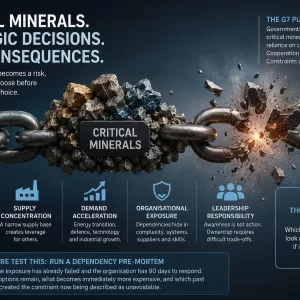
Critical Minerals and the Leadership Risk of Strategic Dependency
The G7’s critical minerals push reveals a boardroom issue beyond supply chains: organisations often tolerate known dependencies until events turn them into strategic constraints.
17 Jun 2026
AI, Social Media Bans and The Capture: How Institutions Redesign Reality
Argentina’s AI-company proposal, the UK’s under-16 social media ban and the BBC’s The Capture all point to the same leadership pattern: institutions relaxing ethical boundaries when pressure, protection or profit make the compromise feel justified.
15 May 2026
TG Jones, Post Office Closures and the Governance Risk in Outsourced Services
The TG Jones restructuring is being discussed as a high street and private equity story. The deeper leadership issue is how essential services become fragile when they depend on commercial partners under pressure.
Get in touch
We want to hear from you
If you're ready to break bias, decode decisions and unlock success, we're here to help. Let's get your transformation journey started!