
Critical Minerals and the Leadership Risk of Strategic Dependency
The G7’s critical minerals push reveals a boardroom issue beyond supply chains: organisations often tolerate known dependencies until events turn them into strategic constraints.
Share this article:
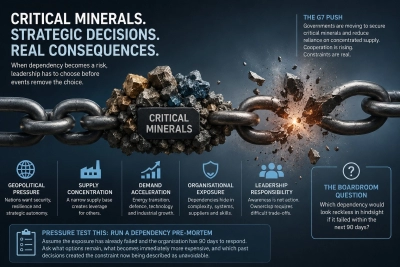
The G7’s move to coordinate critical minerals supply chains, including rare earths, is the strongest signal. France has convened G7 discussions on reducing dependence on China, while G7 countries are also discussing a permanent secretariat to keep the critical minerals agenda moving beyond rotating presidencies. (Reuters)
What’s Happening
On 6 May 2026, G7 trade ministers met in Paris with critical minerals and rare earth supply chains on the agenda. French trade minister Nicolas Forissier framed the issue around avoiding dependency on countries that dominate the market. This follows France’s separate announcement that it wants to rebuild a domestic rare earths and permanent magnets supply chain, with Lacq positioned as a rare-earth processing hub. (Reuters)
France’s plan goes beyond raw material access. It targets the full chain from overseas supply through refining, alloy production and magnet manufacturing. By 2030, France says it wants to produce rare earth oxides covering all European demand for heavy rare earths, around a quarter of light rare earth demand, and around 10% of European alloy needs. (Reuters)
What’s Being Said
The public language is about resilience, sovereignty, security and reducing exposure to China’s dominance in minerals needed for defence, energy transition and manufacturing. Reuters reports that the G7 is discussing a permanent secretariat, potentially housed at the IEA or OECD, to maintain continuity and execute decisions after the June leaders’ summit. (Reuters)
There is also tension beneath the cooperation. Reuters reports that some European governments prefer national control of stockpiles rather than a single shared reserve, and some do not want the US to lead the project because of concerns about access during a crisis. That matters because everyone agrees on the need for resilience, but there is less agreement about control, funding and priority when supply tightens. (Reuters)
What I’ve Noticed
Critical minerals have moved from procurement issue to strategic exposure.
For years, many organisations have treated dependency as a manageable operating condition. A concentrated supplier base. A dominant technology platform. A single market that carries too much growth. A key person who quietly holds the system together. These dependencies often sit in plain sight, but they remain tolerable while the economics still work.
The G7 discussion shows what happens when efficiency is reclassified as vulnerability. Once a dependency becomes political, regulated or strategically scarce, the organisation no longer gets to manage it on its own timetable.
That is the leadership lesson. Many risks do not become serious because they were invisible. They become serious because leadership allowed them to remain in the wrong conversation for too long. Procurement monitors. Operations adapts. Finance models. Risk records. But only the board and executive team can decide that a dependency has become strategically unacceptable.
Pressure Test this:
Run a dependency pre-mortem. Assume the exposure has already failed and the organisation has 90 days to respond. Ask what options remain, what becomes immediately more expensive, and which past decisions created the constraint now being described as unavoidable.
Read more blog posts
29 Jun 2026
AI Is Reshaping C-Suite Roles, But Accountability Is the Harder Test
AI is no longer only a technology or productivity issue. It is changing senior leadership roles, board oversight and the ownership of judgement when decisions become faster, more automated and less visible.
13 May 2026
AI Investment and the Leadership Risk of Mistaking Momentum for Value
The AI investment debate is focused on scale, speed and return. The overlooked leadership issue is whether organisations can prove that major investment is converting into real value for customers, margin, risk, people and decision quality.
28 May 2026
AI Is Quietly Breaking Lean Systems
AI is increasing organisational workload while reducing human capacity. The hidden risk is not productivity failure, but the erosion of lean principles that protect flow, quality and judgement.
Get in touch
We want to hear from you
If you're ready to break bias, decode decisions and unlock success, we're here to help. Let's get your transformation journey started!