
Simple by Design, Not by Origin
A leadership charter should do more than state good intentions. This one is designed to make leadership expectations visible, expose differences in perspective and reveal where agreed behaviours are not showing up in practice.
Share this article:
The work behind Agile Mindset Mastery has been developed deliberately around a central question:
What helps leaders make better decisions, strengthen behaviour and create sustained organisational progress when pressure and consequence increase?
Over time, that question has expanded into a wider architecture of frameworks, pathways and practical tools.
But recently I found myself asking a different question:
What is the simplest practical expression of that thinking that a leadership team could actually use?
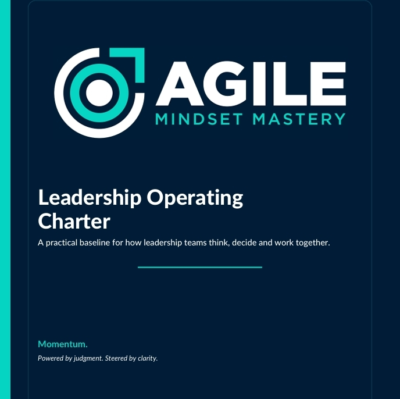
The result is the AMM Leadership Operating Charter.
It is a deliberate distillation of the wider Agile Mindset Mastery philosophy and leadership operating framework into a lightweight set of agreements that can be adopted without training, facilitation or consultant-led implementation.
The intention is not to create another values exercise or generic team charter.
It is to provide leadership teams with a practical baseline for how they intend to operate when priorities compete, information is incomplete, challenge is required and decisions carry consequence.
"A practical baseline for how Leadership Teams intend to operate when priorities compete, information is incomplete, challenge is required and decisions carry consequence."
What the Charter is designed to do
It helps make visible where a leadership team is aligned, where perspectives differ and where agreed behaviours may not be showing up in practice.
That matters because leadership teams can agree with a principle while experiencing the organisation very differently.
One person may believe challenge is actively encouraged.
Another may experience it as something that happens only after the meeting.
One leader may believe decision ownership is clear.
Another may see decisions repeatedly travelling upwards.
The differences are not something to eliminate quickly.
They are information.
The value comes from understanding why people are seeing the same operating environment differently.
"Simple by design, not by origin."
Why it is deliberately simple
Simple by design, not by origin.
Behind its six commitments sits around 18 months of focused Agile Mindset Mastery development, hundreds of hours of research and applied work, and a much longer body of leadership experience.
That work has included sustained research and book synthesis across judgement, decision making, cognitive bias, psychological safety, team dynamics, organisational behaviour and leadership under pressure.
The Charter is deliberately lightweight because the complexity has already been worked through behind it.
The value of the Charter is not how much is in it. It is how much has been taken out.
The intention is that a leadership team should not need to learn a methodology before it can benefit from the thinking.
It should be possible to pick it up, use it and begin observing what happens.
From agreement to behaviour
The Charter is not intended to sit in a folder after a workshop.
Its usefulness comes from what happens after the agreements are made visible.
Do people raise concerns earlier?
Do leaders ask for evidence rather than assertion?
Does challenge happen before decisions close rather than afterwards?
Is ownership clearer?
Are decisions revisited because new evidence has emerged, or simply because someone remains uncomfortable with them?
Those are observable behaviours.
And where a team agrees with the principle but repeatedly behaves differently, a more useful question begins to emerge:
What is causing us to operate differently from what we already agree is right?
That is often where the deeper work begins.
Use it as a living reference
The Charter is intended to be adapted from evidence rather than treated as something fixed.
Pick it up. Use it. Observe what happens. Adapt it from evidence.
A leadership team may find that simply making expectations explicit is enough to change behaviour.
It may discover that people hold very different expectations about how the team should operate.
Or it may discover something more interesting:
Everyone agrees with the intended behaviour, but the behaviour still does not happen consistently.
All three outcomes are useful.
The point is to make what is usually implicit visible enough to discuss.
Advance copies
I am now preparing the first branded release and will make a small number of advance copies available before wider publication.
All I would ask is that you use it and tell me whether it created a conversation worth having.
If you lead, sit within or work closely with a senior leadership team and would like an advance copy, reply to this post or contact me directly.
Request your copyRead more blog posts
23 Mar 2026
What Do I Need a Coach For? I Got This!
High performers often believe they don’t need a coach. But what if that belief is quietly limiting results, slowing decisions, and leaving opportunity on the table? This piece explores the real cost of going it alone and what changes when you don’t.
21 Jul 2025
How AI is Reshaping Agile Delivery (and What to Do Next)
Agile delivery is being redefined—not by new frameworks, but by new intelligence. As tools like Jira AI and ClickUp start predicting, prioritising, and prompting on our behalf, one question emerges: Who’s driving the sprint now?
24 Apr 2026
Why Rising Commercial Insurance Costs Are a Board-Level Leadership Signal
As insurers tighten cover and reprice risk, businesses are being forced to own exposures they once transferred. The real issue is not insurance cost, but leadership’s understanding of operational risk.
Get in touch
We want to hear from you
If you're ready to break bias, decode decisions and unlock success, we're here to help. Let's get your transformation journey started!