
Target’s Turnaround Shows Why Customer Friction Is an Accountability Problem
Target’s supply chain appointment reveals a wider leadership signal: customer trust is often lost through accumulated operational friction long before leaders name it as a commercial risk.
Share this article:
"When every function can explain its part, the customer still experiences the whole system, AND the Friction."
Target’s turnaround, Jeff England’s appointment as chief global supply chain and logistics officer, and the leadership question of who owns accumulated customer friction. Source topic and factual base taken from the supplied draft.
What’s Happening
Target has appointed Jeff England, a former Walmart executive, as executive vice president and chief global supply chain and logistics officer. He is due to start on 31 May and will report to COO Lisa Roath, with responsibility for accelerating Target’s supply chain plans and improving the shopping experience.
The appointment comes as Target’s new CEO, Michael Fiddelke, pushes a broader turnaround. Target has reported stronger first-quarter trading, including net sales growth of 6.7%, comparable traffic growth of 4.4%, digital comparable sales growth of 8.9%, and same-day delivery growth of more than 27%.
Reuters has also reported that Target has opened its first receive centre in Houston to manage upstream inventory and reduce congestion in stores and distribution centres. The company has also been investing in store employees, reducing some corporate roles and lowering prices on thousands of products as part of the wider performance effort.
What’s Being Said
Most commentary is focused on whether Target’s turnaround is beginning to work. The company has raised its full-year net sales growth expectation to around 4%, but investors remain cautious. Shares reportedly fell in early trading despite the improved forecast, suggesting the market is still testing whether the recovery is durable.
The appointment of a former Walmart supply chain leader is being read as a practical move to restore operational discipline. The sharper signal is that Target appears to be treating customer trust as an operating problem, not only a brand problem.
What I’ve Noticed
Some turnarounds are really arguments about who owns the friction.
Target’s move matters because it points beyond retail logistics. When a business strengthens supply chain leadership during a turnaround, it is often acknowledging that customer trust is not rebuilt through proposition alone. It is rebuilt through the reliability of the operating system.
Customers do not experience strategy through leadership language. They experience it through stock availability, price confidence, delivery reliability, substitutions, store standards, queue length, returns and whether the business feels easier or harder to deal with than it used to.
That is where performance drift hides.
The damage is rarely dramatic at first. A shelf gap here. A poor substitution there. A delivery that feels less dependable. A store that feels slightly harder to shop. A promotion that creates more confusion than confidence. Each moment may be explainable. Together, they teach the customer to change behaviour.
Leadership teams often miss the accumulation because the organisation sees the problem in fragments. Supply chain explains availability. Stores explain labour pressure. Digital explains fulfilment. Finance explains margin. Merchandising explains range and value. Marketing explains perception.
Each function can be rational.
The customer still experiences the combined effect.
What This Means
The hidden leadership issue is accountability for friction.
Every mature business has friction. The governance question is whether anyone owns it end to end. In many organisations, friction is divided into functional explanations until the total commercial effect becomes harder to see.
That is how capable organisations drift. Not because people are careless. Not because effort is absent. Because the system allows each function to defend its own compromise while the customer experiences the cumulative cost.
The commercial cost rarely appears under one heading. It may show up as missed sales, heavier markdowns, reduced repeat purchase, higher service costs, more management escalation, slower decisions and teams spending energy compensating for constraints that should have been removed. By the time the issue is visible as underperformance, the organisation may have been paying for it twice: once in lost customer confidence, and again in the internal effort required to work around the problem.
This is where executive judgement becomes difficult. The leadership team has to decide whether underperformance is a strategy problem, an execution problem, a structure problem or an accountability problem. Those categories overlap, but they require different interventions. Misdiagnosis is expensive.
A brand refresh will not fix operational drag. A cost programme will not restore trust if it removes capability from the places where trust is made. A new executive appointment will not change much if the organisation keeps allowing friction to be owned in fragments.
"Pressure Test"
Pressure Test:
If customer trust is weakening, can your executive team name the three points of friction doing the most commercial damage, the executive who owns each one end to end, the trade-off required to remove them, and the protected priority that would have to give way?
If that question creates hesitation, the organisation may not need another workstream. It may need a reset of ownership.
Hesitation often reveals that the friction is known, but not yet governable. People can describe it, explain it and sympathise with the customer. The harder move is to stop allowing each function to defend its own compromise while the customer experiences the combined cost.
The first practical response is to make friction visible as one commercial issue. Put customer impact, margin effect, operating constraint and decision ownership into the same conversation. Then force the leadership choice: what will be removed, what will be deprioritised, and who has the authority to break the internal settlement that allowed the problem to persist.
That is where many teams stall. They can describe the friction. They can agree that action is needed. They can commission more analysis. The harder act is reallocating authority, budget, attention or talent away from something already defended.
Turnarounds do not fail only because leaders misread the market. They fail because the organisation keeps negotiating with the friction.
If this feels familiar, it is worth having the conversation before the numbers force it. Some leadership tensions are easier to resolve while they are still private.
Customer experience is often treated as an outcome when it is really a governance test.
Book a free, confidential callIf a similar pattern is showing up in your own leadership, team, or organisation, the Leadership Actualisation Snapshot is designed to help clarify what may really be driving it.
The process offers a structured, low-pressure way to experience what coaching and reflection can genuinely provide before deciding whether deeper engagement is right for you.
Availability is intentionally limited each month to maintain depth, preparation, and quality of engagement.
Reserve a £99 Leadership Actualisation Snapshot.Read more blog posts
14 May 2026
What the AWS outage reveals about independent AI data centres, cloud resilience and local infrastructure
The AWS overheating outage was more than a cloud reliability issue. It exposed a wider leadership question about whether some AI workloads now need local, sovereign or independent infrastructure designed around resilience, accountability and operational control.
06 May 2026
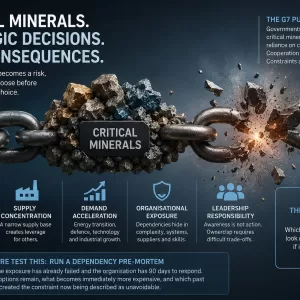
Critical Minerals and the Leadership Risk of Strategic Dependency
The G7’s critical minerals push reveals a boardroom issue beyond supply chains: organisations often tolerate known dependencies until events turn them into strategic constraints.
29 Jul 2025
Mindset Is Your Operating System
Unlock leadership clarity, fix transformation bottlenecks, and overcome decision fatigue with mindset tools, emotional intelligence frameworks, and bias-aware systems—built for agile teams, waterfall programs, and high-pressure business environments.

Get in touch
We want to hear from you
If you're ready to break bias, decode decisions and unlock success, we're here to help. Let's get your transformation journey started!