
Why Global M&A Is Really a Test of Leadership Capacity
A new wave of overseas acquisitions by Indian companies reveals a broader leadership pattern: businesses are buying capability because internal development cycles cannot keep pace with strategic pressure.
Share this article:
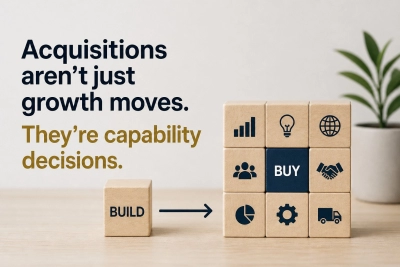
Indian companies are making a more assertive move into global acquisitions, with Sun Pharma’s planned $11.75 billion acquisition of Organon sitting alongside Coforge’s $2.35 billion acquisition of Encora and Tata Motors’ earlier purchase of Iveco. The signal is not simply “Indian companies are going global”. It is that growth, capability, supply chain resilience and market access are now being bought rather than built. (Reuters)
What’s Happening
Reuters reports that Indian outbound M&A is accelerating, with 56 outbound transactions worth $3.9 billion in the first quarter of 2026, after 162 deals worth $18.2 billion in 2025. The deals span pharma, technology and industrials, and are being driven by access to products, R&D, technology, customers and distribution. Reuters also notes that corporate balance sheets are cleaner than during the early 2000s overseas acquisition wave, with median debt-to-EBITDA for rated Indian corporates at 0.5 times as of March 2026. (Reuters)
What’s Being Said
The market commentary is cautiously positive. Advisers quoted by Reuters argue that this cycle looks more disciplined, with a mix of internal cash and moderate leverage. There is also a strong strategic logic being attached to the deals: companies are buying capability where it is hard to build domestically and buying global scale where organic growth would take too long. The caution is around execution and debt discipline, particularly where a historically conservative balance sheet moves into a more leveraged position. (Reuters)
What I’ve Noticed
The important leadership signal is the shortening patience for organic capability building. Boards are no longer only asking whether a business can grow. They are asking whether it can grow quickly enough, with enough control, in markets that are becoming more fragmented and less predictable.
That changes the quality of the decision. Acquisition becomes less about ambition and more about compression. Compressing time to market. Compressing capability gaps. Compressing exposure to supply chain and trade friction. But every compressed decision carries a hidden cost. The organisation still has to absorb the complexity at normal human and operating speed.
Have a question?
Click here to submitTo Pressure Test this:
Ask the executive team to name the three capabilities the acquisition is meant to create, then ask who will own each one eighteen months after completion when the deal team has moved on.
Read more blog posts
19 Feb 2026
Why Your Next CEO Should Be An Octopus
If you want a CEO who can navigate volatility, complexity, and uncertainty without pretending the world is stable…
Give the job to the octopus.
If you can’t hire an octopus,
design leadership that behaves like one.
29 Apr 2026
What ASX Reveals About Leadership, Resilience and Deferred Risk
The ASX inquiry shows how leadership failures often build through rational decisions, deferred investment and risks that become normalised before they become public.

02 Feb 2026
Decision Integrity: an executive responsibility
Executive decisions rarely fail due to lack of information. They fail when judgement is shaped by bias, culture, and unchallenged framing. This piece explores why decision integrity is an executive responsibility, and why independent critical thinking is often required to protect it.
Get in touch
We want to hear from you
If you're ready to break bias, decode decisions and unlock success, we're here to help. Let's get your transformation journey started!